
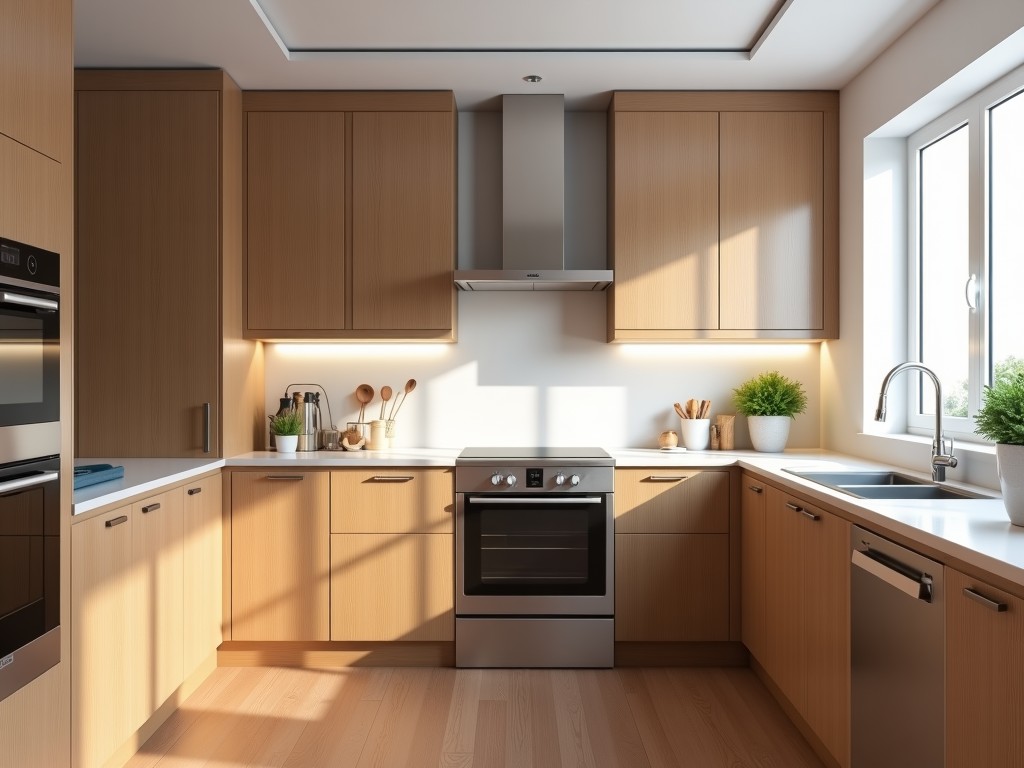
Shaker cabinets feature a five-piece door with a recessed center panel, typically constructed from a frame of stiles and rails surrounding a flat panel. This design provides a clean line aesthetic
Inquire NowShaker cabinets feature a five-piece door with a recessed center panel, typically constructed from a frame of stiles and rails surrounding a flat panel. This design provides a clean line aesthetic while allowing for dimensional stability across temperature and humidity fluctuations.
Common substrate materials include 18 mm thick three‑ply plywood with a density of approximately 600 kg/m³, 16 mm particleboard faced with melamine resin, and 19 mm medium‑density fiberboard (MDF) with a uniform density of 700 kg/m³. Each option is selected based on required load‑bearing capacity, edge‑finish quality, and cost targets.
Joinery methods directly affect long‑term performance. Dovetail joints provide tensile strength exceeding 2 kN for drawer assemblies, while cam‑lock and dowel systems achieve shear resistance around 1.5 kN for cabinet carcasses. Face‑frame construction uses 38 mm × 19 mm hardwood stiles with mortise‑and‑tenon joints, whereas frameless designs rely on full‑overlay panels bonded with polyurethane adhesive.
| Material | Typical Thickness | Density (kg/m³) | Recommended Use |
|---|---|---|---|
| 3‑ply plywood | 18 mm | 600 | High‑load cabinets, wet areas |
| Melamine particleboard | 16 mm | 650 | Standard indoor cabinets |
| MDF | 19 mm | 700 | Painted finish, smooth edges |
Dimensional flexibility allows widths in 50 mm increments from 150 mm to 900 mm, heights adjustable in 100 mm steps from 300 mm to 2400 mm, and standard depths of 300 mm, 350 mm, or 600 mm. Overlay options include full overlay (door covers 100 % of face frame), half overlay (50 %), and inset (door sits flush within the frame).
Interior accessories are specified using 32 mm shelf‑pin spacing, allowing adjustable shelving with load ratings up to 30 kg per shelf. Drawer boxes can be configured with full‑extension ball‑bearing slides rated for 40 kg dynamic load.
Surface finishes are applied in controlled environments to achieve consistent film thickness. Paint systems typically deliver a dry film thickness of 60 µm with adhesion measured by ASTM D3359 (5B rating). Stain finishes penetrate 10‑15 µm into the wood substrate and are sealed with a two‑component polyurethane topcoat of 40 µm thickness. Laminate overlays are bonded at 180 °C with a peel strength exceeding 1.8 N/mm.
The timeless aesthetic of shaker doors suits both residential kitchens and commercial food‑service environments because the recessed panel reduces surface area for grease accumulation, simplifying cleaning. Modular dimensions enable rapid reconfiguration of line layouts in institutional settings, while the robust joinery supports heavy‑duty use in hospitality pantries.
Dimensional verification occurs at three stages: after panel cutting (±1 mm tolerance), after assembly (squareness <0.5 mm diagonal difference), and after finish application (film thickness uniformity ±5 µm). Edge‑band adhesion is tested via a 90° peel test, requiring a minimum force of 1.2 N/mm.
Load testing of completed cabinets includes a static shelf load of 50 kg for 24 hours with deflection limited to 2 mm, and door cycle testing of 20 000 openings with hinge wear remaining below 0.1 mm.
Products are prepared for shipment using corner protectors made of 3 mm expanded polystyrene, stretch‑wrapped in 70 µm polyethylene film, and stacked on ISO‑standard pallets with a maximum load of 800 kg per pallet. Each pallet is labeled with SKU, dimensions, and handling instructions.
Production schedules are based on final approved drawings and material availability. Typical lead time for standard shaker configurations ranges from 20 to 28 working days, while projects requiring non‑standard finishes or extended dimensions may extend to 35‑40 working days.
Can dimensions be customized? Yes, width, height, and depth are adjustable in the increments listed above; custom mullion layouts are available upon request.
What information is required before quotation? A detailed layout plan, desired material, finish type, hardware specifications, and any required accessories (e.g., pull‑out trays, lighting).
What materials are available? The standard offering includes 3‑ply plywood, melamine particleboard, and MDF; alternative substrates such as solid hardwood or bamboo are available for special orders.
How is quality inspected? Inspection includes dimensional checks, squareness verification, finish adhesion testing, and load validation as described in the Quality Assurance section.
What packaging methods are available? Standard flat‑pack with corner protection and stretch film; optional crate packaging for overseas shipments is offered.
How are export shipments protected? Pallets are secured with poly‑strapping, corner boards, and a top‑layer of corrugated cardboard to resist impact and moisture during transit.
What is the typical production lead time? See the Lead Time and Ordering section for standard ranges; exact timing is confirmed after order entry.
How are samples arranged? Sample doors or full cabinet sections can be produced upon receipt of a signed sample agreement and are shipped via express courier.
To begin a quotation, please provide your project specifications via the contact form.
Request QuoteQueenswood delivers modern bathroom solutions through original design, advanced manufacturing, and reliable quality for customers worldwide.


Middle of Xingang East Road, Haizhu District, Guangzhou City, Guangdong Province

