
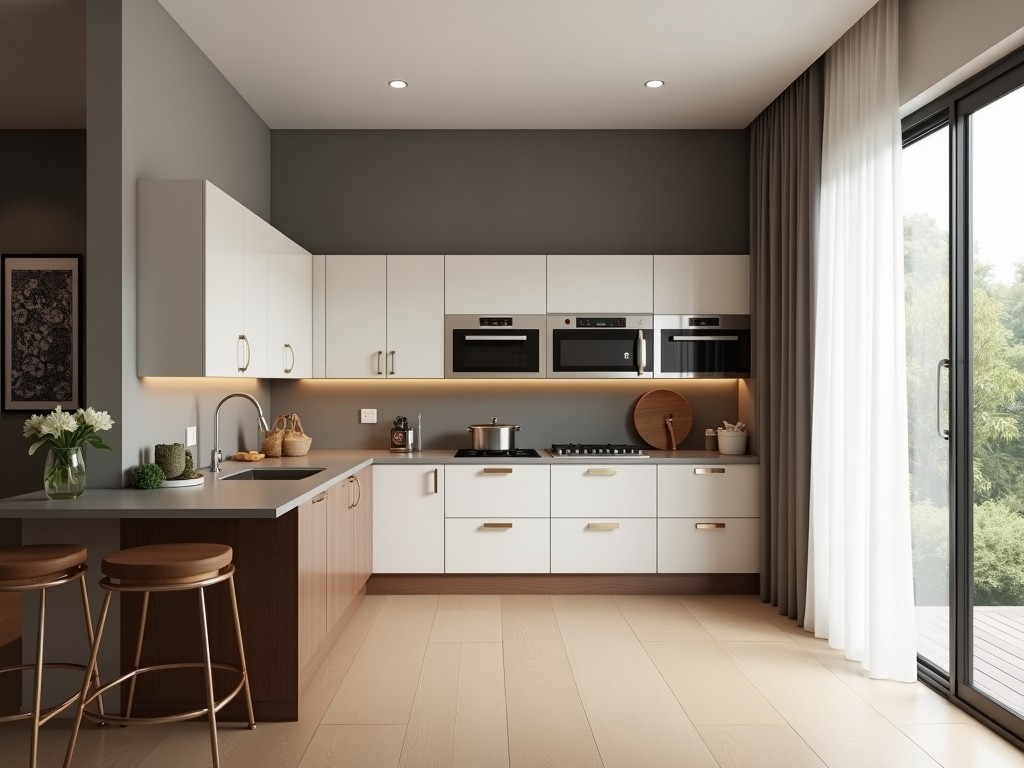
Wholesale custom modern kitchen cabinets are produced in volume for developers, contractors, and renovation firms that require consistent design across multiple units. Each unit is built to the same
Inquire NowWholesale custom modern kitchen cabinets are produced in volume for developers, contractors, and renovation firms that require consistent design across multiple units.
Each unit is built to the same dimensional tolerances and finish specifications to simplify installation and reduce on‑site adjustments.
Ordering in bulk allows the manufacturer to optimize material nesting and reduce per‑unit waste.
Lead times are typically shorter than for one‑off custom jobs because production lines can be set up for repeatable runs.
Pricing reflects economies of scale while still accommodating project‑specific modifications.
Modern aesthetics favor flat‑panel doors, minimal hardware, and neutral color palettes.
These characteristics translate into specific material and construction choices that support both visual appeal and long‑term durability.
The cabinet carcass is most commonly fabricated from 18 mm thick birch or hardwood plywood, which provides a bending strength of approximately 45 MPa and a density of 600–650 kg/m³.
For cost‑sensitive projects, 16 mm particleboard with a melamine face is available; its internal bond strength averages 0.8 MPa and its thickness tolerance is ±0.2 mm.
Face veneers or laminate overlays are applied to the exterior surfaces, with typical thicknesses ranging from 0.2 mm for paper‑based laminate to 1.5 mm for real wood veneer, affecting both appearance and wear resistance.
Carcass panels are joined using concealed cam locks and dowel pins, delivering a shear strength of about 2.5 kN per joint and allowing disassembly for flat‑pack shipping.
Edge banding is applied with hot‑melt adhesive, typically 0.5 mm thick PVC or ABS, providing impact resistance and sealing the core against moisture ingress.
Door assemblies incorporate 35 mm soft‑close hinges rated for 30 000 cycles and drawer slides with a dynamic load capacity of 30 kg per pair.
Overall cabinet height, width, and depth can be adjusted in 1 mm increments to match field measurements, with standard base heights of 720 mm, 800 mm, and 900 mm.
Available door styles include slab, shaker, and flat‑panel with optional glass inserts; each style changes the required machining time and tooling.
Interior accessories such as pull‑out shelves, lazy Susans, and drawer organizers can be specified, adding between 0.5 kg and 2 kg of hardware per unit.
Finishes range from high‑gloss polyurethane lacquer (dry film thickness 40–60 µm) to matte melamine overlay (dry film thickness 30–45 µm), influencing both scratch resistance and UV stability.
Hardware options include concealed hinges with 110° opening angle, soft‑close dampers rated at 2 Nm torque, and full‑extension drawer slides with anti‑tilt mechanisms.
Handles can be omitted for a handle‑less look, or selected from stainless steel bar pulls (diameter 12 mm, length 150 mm) or recessed finger grips.
Dimensional inspection verifies that overall cabinet dimensions remain within ±2 mm of the approved drawing, using calibrated calipers and coordinate‑measuring machines.
Moisture content of wood‑based panels is maintained between 8 % and 12 % to prevent post‑installation swelling or shrinkage.
Adhesion testing of finishes follows ASTM D3359, requiring a minimum rating of 4B for acceptable bond strength.
Each production lot undergoes a random sample audit of 5 % of units, with functional tests on hinges and slides to confirm cycle life and load performance.
Multifamily residential projects benefit from uniform cabinet dimensions, which streamline rough‑in plumbing and electrical rough‑ins and reduce change‑order costs.
Hospitality installations, such as hotel suites or extended‑stay apartments, require finishes that resist frequent cleaning and mild chemical exposure, making high‑gloss lacquer or PVC laminate suitable choices.
Commercial kitchenettes in office buildings or retail spaces often demand fire‑rated substrates; in these cases, the manufacturer can substitute FR‑grade plywood meeting ASTM E84 Class B rating.
| Parameter | Standard Option | Customizable Range |
|---|---|---|
| Carcass Thickness | 18 mm plywood | 16 mm particleboard, 20 mm hardwood |
| Door Thickness | 19 mm slab | 22 mm shaker, 25 mm inset |
| Finish Type | Matte melamine | High‑gloss lacquer, textured veneer |
| Hinge Type | Soft‑close concealed 110° | Soft‑close 90°, push‑to‑open |
| Drawer Slide Load | 30 kg per pair | 45 kg per pair, full‑extension with soft‑close |
| Edge Banding | 0.5 mm PVC | 1.0 mm ABS, wood veneer |
| Interior Accessories | Basic shelf | Pull‑out tray, lazy Susan, spice rack |
Yes, each cabinet can be tailored to specific millimeter‑level measurements to fit unique layout constraints.
To generate a quote we need the overall layout, desired door style, finish selection, hardware preferences, and any required interior accessories.
Carcass options include 18 mm plywood, 16 mm particleboard, or 20 mm hardwood; door substrates match the carcass material or can be upgraded to MDF with veneer.
Inspection occurs at three stages: incoming material verification, in‑process dimensional checks, and final functional testing of hinges, slides, and finish adhesion.
Queenswood delivers modern bathroom solutions through original design, advanced manufacturing, and reliable quality for customers worldwide.


Middle of Xingang East Road, Haizhu District, Guangzhou City, Guangdong Province

