
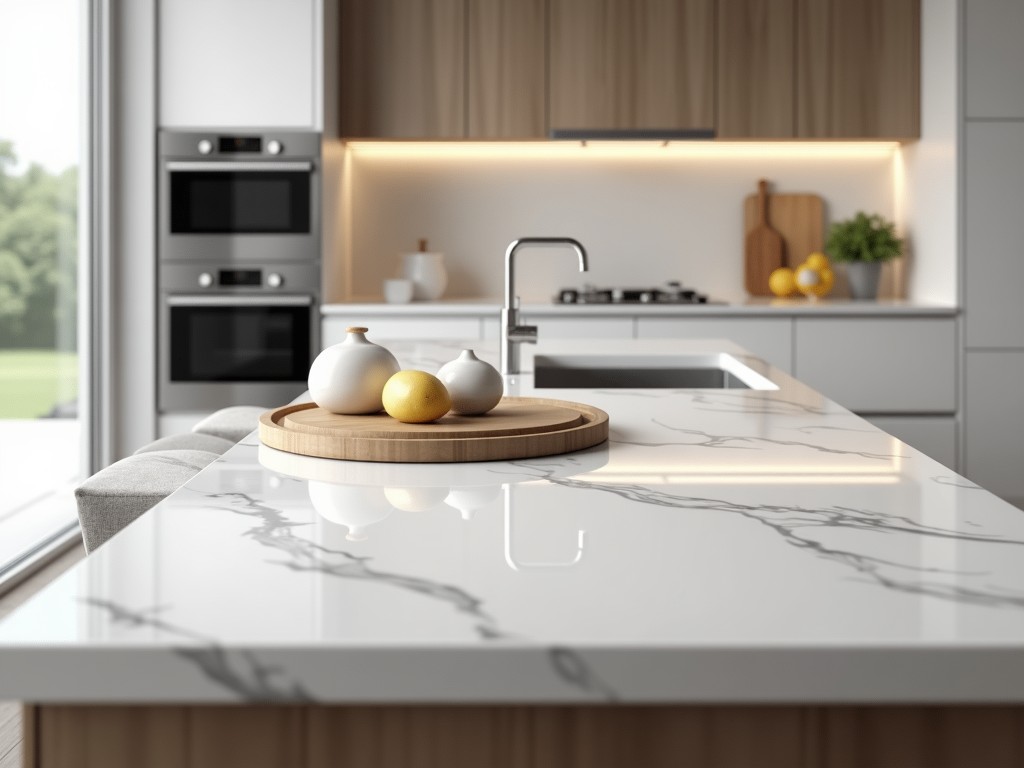
Engineered quartz countertops consist of approximately 90 % ground natural quartz aggregate bound with polymer resins and pigments. The resulting slab is non‑porous, homogeneous, and exhibits
Inquire NowEngineered quartz countertops consist of approximately 90 % ground natural quartz aggregate bound with polymer resins and pigments. The resulting slab is non‑porous, homogeneous, and exhibits consistent coloration across the surface.
White quartz variants achieve their hue through titanium dioxide or similar pigments, providing a bright appearance that does not rely on natural veining. This uniformity simplifies matching across multiple slab installations.
Typical quartz content ranges from 90 % to 94 % by weight, with the remainder comprising unsaturated polyester or acrylic resins, crosslinking agents, and UV stabilizers. The resin system imparts flexibility while the quartz aggregate provides hardness.
Mechanical properties commonly reported include compressive strength exceeding 150 MPa, flexural strength around 50 MPa, and water absorption below 0.02 % by weight. Thermal expansion coefficient is approximately 25 × 10⁻⁶ /°C, allowing stable performance under typical kitchen temperature fluctuations.
Surface finishes such as polished, honed, or leathered alter the coefficient of friction and visual reflectance. Polished finishes yield a gloss level above 70 GU, while honed surfaces reduce glare and provide a matte appearance with a slip‑resistant rating suitable for wet zones.
Slab production begins with vacuum‑mixing of quartz aggregate, resin, and pigments, followed by vibration pressing under pressures of 100 kN or more to eliminate air voids. The cured slab then passes through a calibration stage to achieve target thickness tolerances of ±0.5 mm.
After curing, slabs are polished using sequential diamond abrasives to reach the specified finish. Inline inspection stations monitor thickness, color uniformity via spectrophotometry, and surface defects using high‑resolution imaging. Edge profiling is performed CNC‑based to meet radius and angle specifications.
Material cost is driven primarily by quartz purity, resin brand, and pigment load. Higher quartz content generally increases raw material price but improves hardness and chemical resistance.
Slab thickness (commonly 2 cm or 3 cm), edge profile complexity (eased, bullnose, ogee, waterfall), and finish type affect fabrication time and waste. Transportation distance, site accessibility, and installation labor further influence the final quoted price, which is typically expressed per square foot.
| Thickness (cm) | Edge Profile | Typical Price Range (USD/ft²) |
|---|---|---|
| 2 | Eased | 55 – 70 |
| 2 | Bullnose | 60 – 78 |
| 3 | Eased | 70 – 90 |
| 3 | Waterfall | 85 – 110 |
The non‑porous nature of quartz prevents liquid absorption, reducing the risk of staining from common kitchen substances such as wine, oil, and acidic foods. This property supports hygienic surfaces required in food preparation areas.
White quartz withstands brief exposure to temperatures up to 150 °C, making it suitable for proximity to cooktops when used with trivets. Its impact resistance exceeds that of natural marble, lowering the likelihood of chipping during heavy‑use scenarios.
Typical installations include continuous countertop runs, kitchen islands with overhangs for seating, integrated backsplashes, and bar tops. The material’s consistent color allows seamless matching across multiple fabrications.
| Property | Quartz | Granite | Solid Surface | Laminate |
|---|---|---|---|---|
| Porosity | Non‑porous | Low (requires sealing) | Non‑porous | Non‑porous (surface) |
| Stain Resistance | Excellent | Good (with sealant) | Excellent | Moderate |
| Heat Resistance (°C) | ≈150 (brief) | ≈250 | ≈120 | ≈80 |
| Impact Strength | High | Moderate | Moderate | Low |
| Maintenance | Clean with mild detergent | Periodic sealing | Clean with mild detergent | Clean with mild detergent |
| Typical Cost (USD/ft²) | 55 – 110 | 45 – 100 | 40 – 80 | 15 – 30 |
For detailed specifications, custom size options, or a project‑specific quotation, please contact our technical sales team. Provide your required dimensions, edge profile, finish, and delivery location to receive a precise cost estimate.
Submit an inquiry to obtain the latest product data sheets and discuss lead times.
Queenswood delivers modern bathroom solutions through original design, advanced manufacturing, and reliable quality for customers worldwide.


Middle of Xingang East Road, Haizhu District, Guangzhou City, Guangdong Province

