
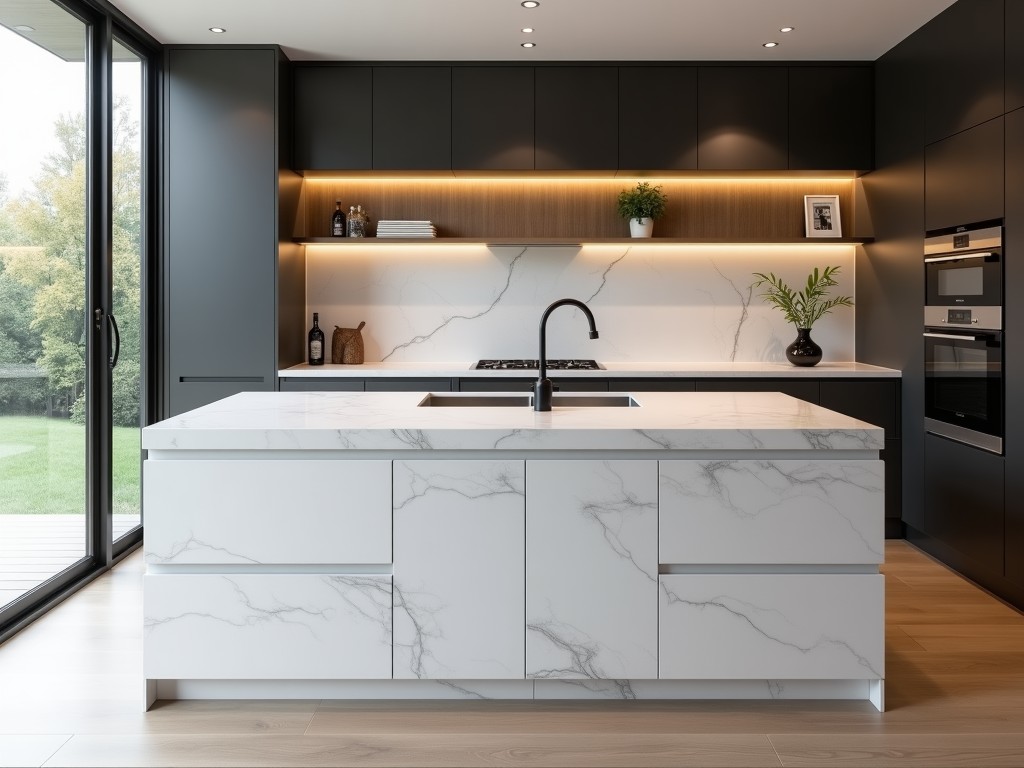
Quartz slabs for kitchen countertops are engineered stone composites consisting of approximately 90‑95 % ground natural quartz aggregate bound with polymer resins and pigments. This composition
Inquire NowQuartz slabs for kitchen countertops are engineered stone composites consisting of approximately 90‑95 % ground natural quartz aggregate bound with polymer resins and pigments. This composition yields a non‑porous surface that resists staining, microbial growth, and chemical attack from common kitchen agents such as acids, oils, and cleaning solvents.
The quartz aggregate is selected for particle size distribution typically ranging from 0.1 mm to 2 mm, which influences the final slab’s density and mechanical interlock. Resin systems are usually unsaturated polyester or acrylic based, cured to achieve a cross‑linked matrix with a glass transition temperature above 80 °C, ensuring stability under typical cooking temperatures.
Pigments are inorganic metal oxides that provide UV stability, preventing discoloration when exposed to prolonged sunlight or indoor lighting. The typical resin content falls between 5‑10 % by weight, balancing flexibility with hardness.
The following table lists typical values for quartz countertop slabs produced under controlled manufacturing conditions. Actual values may vary based on specific formulation and thickness; all data are derived from standard test methods referenced in the table.
| Property | Typical Value | Test Method |
|---|---|---|
| Density | 2.3 g/cm³ | ASTM C97 |
| Compressive Strength | >200 MPa | ASTM C170 |
| Flexural Strength | >50 MPa | ASTM C880 |
| Water Absorption | <0.05 % | ASTM C97 |
| Mohs Hardness | 6‑7 | ASTM C1353 |
| Thermal Expansion Coefficient | 25 × 10⁻⁶ / °C | ASTM E831 |
Raw quartz is crushed, washed, and dried before being blended with measured amounts of resin, pigment, and optional additives such as antimicrobial agents or reflective flakes. The mixture is fed into a vacuum vibration press where it is compacted under pressures of 80‑100 bar to eliminate air voids and achieve uniform density.
After pressing, the slab undergoes a curing cycle in a heated oven typically ranging from 80 °C to 100 °C for 45‑60 minutes, allowing the resin to fully polymerize. Slabs are then calibrated to thickness tolerances of ±0.5 mm, polished with progressively finer diamond abrasives to achieve a gloss level above 70 GU, and inspected for surface defects before shipment.
Wholesale buyers can specify variations that affect both appearance and performance without altering the core quartz‑resin matrix.
The non‑porous nature of quartz prevents absorption of food liquids, reducing the risk of bacterial harborage and simplifying sanitation protocols required by health codes such as FDA Food Code and HACCP guidelines.
High compressive and flexural strengths allow the countertop to support heavy equipment loads—commercial mixers, slicers, and steam tables—without cracking or deflection over typical service lives exceeding 15 years under normal use.
Resistance to thermal shock from hot pans (up to 180 °C) and to chemical attack from citric acid, vinegar, and alkaline cleaners ensures surface integrity in environments where frequent cleaning and temperature cycling occur.
Each production lot undergoes systematic inspection: thickness verification with laser micrometers, surface flatness measured using straight‑edge and feeler gauges (<0.3 mm deviation over 1 m), and gloss measurement calibrated to ISO 2813.
Representative samples are submitted for third‑party testing of water absorption, compressive strength, and chemical resistance. Results are documented in material data sheets supplied with every shipment, enabling buyers to verify compliance with project specifications.
Traceability is maintained through batch numbers etched on the slab underside, linking each piece to resin lot, quartz source, and curing cycle parameters.
Slabs are packed on wooden pallets with edge protectors and interleaving sheets of low‑density polyethylene to prevent chipping and surface abrasion during transit. Standard pallet dimensions accommodate 20 mm thick slabs at a maximum load of 2 tons per pallet, conforming to ISO 1496‑1 for containerized shipping.
For international shipments, moisture‑barrier wraps and corner boards are added, and the cargo is secured with strapping that meets ASTM D3953 specifications. All packages are marked with handling instructions: “Keep Dry, Avoid Direct Sunlight, Handle with Care.”
To discuss your project requirements, request a detailed quotation, or obtain technical data sheets, please contact our sales team.
Request a QuoteQueenswood delivers modern bathroom solutions through original design, advanced manufacturing, and reliable quality for customers worldwide.


Middle of Xingang East Road, Haizhu District, Guangzhou City, Guangdong Province

