
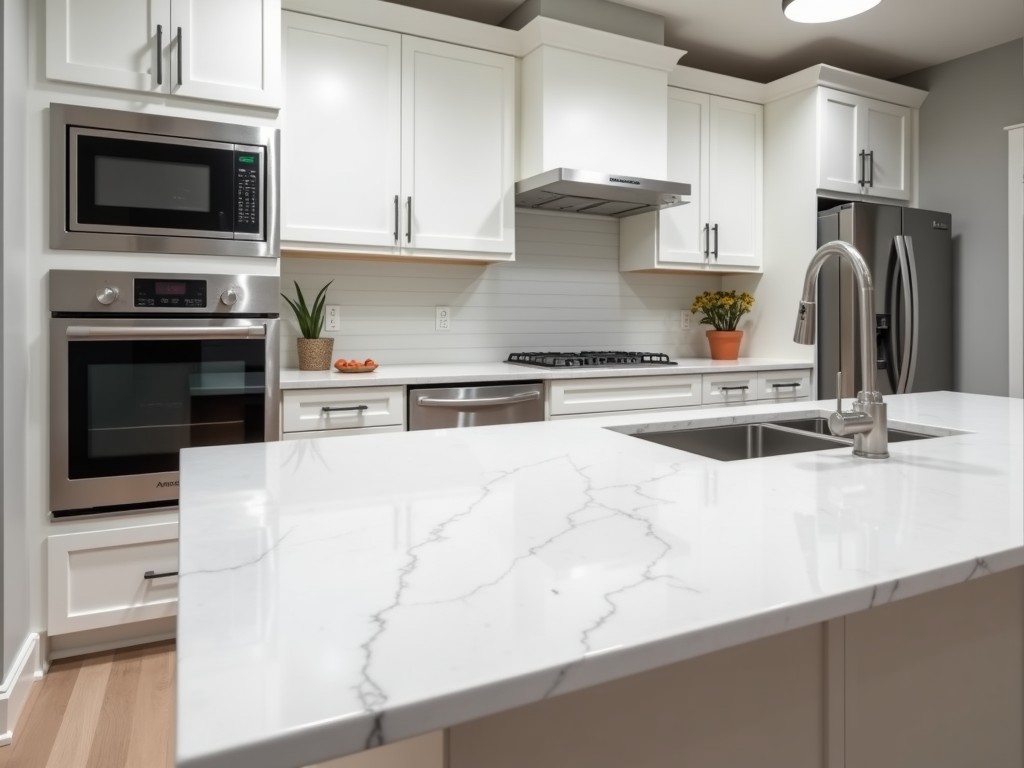
Quartz countertops are engineered stone surfaces made by blending natural quartz aggregate with polymer resin and pigments. The resulting slab is non‑porous, offering consistent color and pattern
Inquire NowQuartz countertops are engineered stone surfaces made by blending natural quartz aggregate with polymer resin and pigments. The resulting slab is non‑porous, offering consistent color and pattern that makes white variants a frequent choice for projects requiring a neutral, bright appearance.
A typical white quartz slab contains 90‑95 % ground quartz by weight, with the remainder consisting of unsaturated polyester or acrylic resin, titanium dioxide pigment for whiteness, and minor additives that improve cure and UV stability. The quartz particles provide the inherent hardness and dimensional stability, while the resin matrix binds the aggregate and imparts flexural toughness.
Particle size distribution is controlled to achieve a dense packing; finer fractions fill voids between larger grains, reducing porosity and contributing to a uniform surface finish after polishing.
Measured properties of quartz countertops reflect the combination of mineral and polymer phases. Typical values include a bulk density of 2.3‑2.5 g/cm³, compressive strength exceeding 100 MPa, and flexural strength in the range of 40‑50 MPa.
Water absorption is low, usually below 0.05 % by weight, which classifies the material as non‑porous. Surface hardness is approximately 7 on the Mohs scale, comparable to that of natural quartz. The coefficient of thermal expansion lies between 20 and 25 × 10⁻⁶ /°C, allowing the slab to withstand typical temperature changes in kitchen or laboratory environments without cracking.
Because the resin seals the quartz particles, the surface resists staining from common substances such as coffee, wine, and mild acids, provided spills are wiped promptly.
The production process begins with a dry blend of quartz aggregate, resin, pigment, and additives, which is then fed into a vacuum mixer to remove air. The mixture undergoes vibration compaction under pressure to achieve the target density before being transferred to a curing oven.
Curing temperatures typically range from 60 °C to 80 °C for a period that allows the resin to polymerize fully. Slabs are produced in standard thicknesses of 2 cm or 3 cm, though other dimensions are available upon request. After curing, the slabs are calibrated, polished to a specified gloss level, and inspected for dimensional accuracy.
In laboratory environments, the non‑porous nature of quartz prevents absorption of reagents and facilitates easy decontamination, supporting compliance with biosafety standards.
Food‑processing facilities benefit from the material’s resistance to bacterial growth and its ability to withstand frequent wash‑down cycles with hot water and mild detergents.
Hospitality installations, such as hotel lobbies and restaurant service counters, rely on quartz’s impact resistance and consistent appearance under high‑traffic use.
Cleanroom applications take advantage of the low particle emission from the sealed surface, helping maintain ISO‑classified air quality.
Dimensional tolerances are held to ±0.5 mm for length and width, and ±0.1 mm for thickness, ensuring tight fit‑up in fabricated assemblies.
Surface finish is quantified by gloss units (typically 70‑90 GU for a polished finish) and inspected visually for pits, scratches, or resin‑rich spots.
Additional checks may include slip resistance (when a honed texture is specified), chemical resistance per ASTM D1308, and impact resistance per ASTM D256.
Slab sizes can be supplied up to 3200 mm × 1600 mm, with thickness options of 12 mm, 20 mm, or 30 mm. Custom lengths and widths are available for projects requiring non‑standard dimensions.
Edge profiles range from simple eased or beveled edges to more decorative bullnose, ogee, or waterfall styles, all produced with CNC polishing to match the slab’s finish.
Integrated backsplashes, pre‑drilled cut‑outs for sinks or cooktops, and matching up‑stands can be fabricated in‑house to reduce on‑site labor.
| Property | White Quartz | Granite | Solid Surface | Laminate |
|---|---|---|---|---|
| Density (g/cm³) | 2.3‑2.5 | 2.6‑2.8 | 1.4‑1.6 | 0.9‑1.2 |
| Compressive Strength (MPa) | >100 | 130‑200 | 50‑80 | 30‑50 |
| Water Absorption (% wt) | <0.05 | 0.1‑0.4 | 0.05‑0.2 | >5 (core) |
| Mohs Hardness | ≈7 | 6‑7 | 3‑4 | 1‑2 |
| Thermal Expansion (×10⁻⁶/°C) | 20‑25 | 4‑9 | 40‑60 | 50‑80 |
Values are typical ranges; actual performance can vary with resin formulation and processing conditions.
Queenswood delivers modern bathroom solutions through original design, advanced manufacturing, and reliable quality for customers worldwide.


Middle of Xingang East Road, Haizhu District, Guangzhou City, Guangdong Province

