
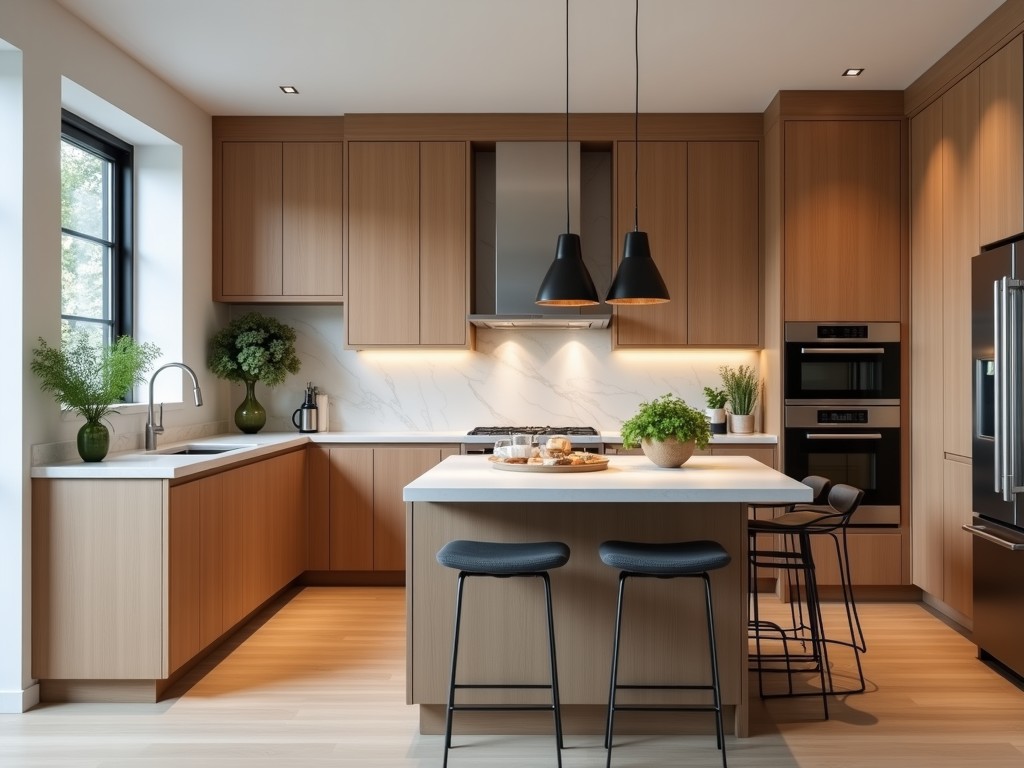
These cabinets are fabricated to tight dimensional tolerances using selected substrate materials and precision joinery, enabling designers to achieve specific aesthetic and functional requirements in
Inquire NowThese cabinets are fabricated to tight dimensional tolerances using selected substrate materials and precision joinery, enabling designers to achieve specific aesthetic and functional requirements in residential and commercial kitchens.
Panel cores typically consist of 19 mm thick three‑ply plywood or medium‑density fiberboard (MDF) with a moisture‑resistant adhesive, providing a modulus of rupture above 30 MPa and dimensional stability under 65 % relative humidity.
Edge sealing is applied with 0.5 mm PVC or ABS edge band, bonded using hot‑melt adhesive to prevent moisture ingress and deliver a uniform surface finish.
Doors are constructed from stile and rail members measuring 70 mm wide and 20 mm thick, joined with double‑dowel mortise‑and‑tenon connections that deliver a shear strength exceeding 15 kN per joint.
A full‑overlay configuration provides a 22 mm door overlay on the cabinet face, minimizing visible gaps and presenting a seamless plane when multiple units are aligned.
Surface finishes include catalyzed polyurethane lacquer applied in two coats to a dry film thickness of 35–45 µm, delivering a pencil hardness of 2H and resistance to common kitchen solvents.
Alternatively, a UV‑cured polyester coating can be specified, offering a film thickness of 30–40 µm, a gloss level of 85 % ± 5 %, and rapid cure times under 2 seconds per pass.
Concealed European hinges are used, rated for a static load of 40 kg per hinge and featuring three‑way adjustment (±2 mm depth, ±1.5 mm side, ±0.5 mm height) with integrated soft‑close dampers that reduce closing speed to 0.2 m/s.
Drawer slides are ball‑bearing, full‑extension types rated for 35 kg dynamic load, with a lateral play of less than 0.1 mm and a service life of 50 000 cycles.
Parts are nested on CNC routers with a positioning accuracy of ±0.15 mm, allowing precise cut‑outs for appliances, plumbing fixtures, and lighting channels.
Tolerances on overall cabinet dimensions are held to ±0.5 mm, ensuring that installed rows align within the visual perception threshold of 1 mm.
| Parameter | Typical Value / Range |
|---|---|
| Panel thickness | 19 mm (plywood) or 18 mm (MDF) |
| Door overlay | 22 mm full overlay |
| Stile width | 70 mm |
| Rail width | 70 mm |
| Hinge load capacity | 40 kg static per hinge |
| Finish thickness (lacquer) | 35–45 µm dry film |
| Edge band type | 0.5 mm PVC or ABS |
| Drawer slide load rating | 35 kg dynamic |
These cabinets are specified in luxury residential kitchens where design continuity and long‑term surface durability are critical, such as custom homes exceeding 300 m² of finished area.
In hospitality environments, the resistance to cleaning agents and the ability to maintain tight joint gaps after repeated use support compliance with health‑and‑safety standards while preserving a premium aesthetic.
The modular panel system enables rapid reconfiguration for showroom kitchens or demonstration units, reducing installation time by approximately 20 % compared with traditional site‑built cabinetry.
Yes, each cabinet is programmed from the supplied CAD layout; CNC cutting accommodates angles, cut‑outs, and protrusions with a positional tolerance of ±0.2 mm.
A detailed plan showing cabinet widths, heights, depths, door overlay preference, finish selection, and hardware specifications enables an accurate material and labor estimate.
Options include 19 mm three‑ply plywood, 18 mm MDF with moisture‑resistant glue, and, upon request, 16 mm high‑density particleboard for budget‑conscious projects.
Each unit undergoes a three‑point check: dimensional verification with a calibrated CMM, finish adhesion test (cross‑hatch per ASTM D3359), and functional operation of hinges and slides under load.
To discuss your specific project requirements and receive a formal quotation, please contact our engineering team.
Queenswood delivers modern bathroom solutions through original design, advanced manufacturing, and reliable quality for customers worldwide.


Middle of Xingang East Road, Haizhu District, Guangzhou City, Guangdong Province

