
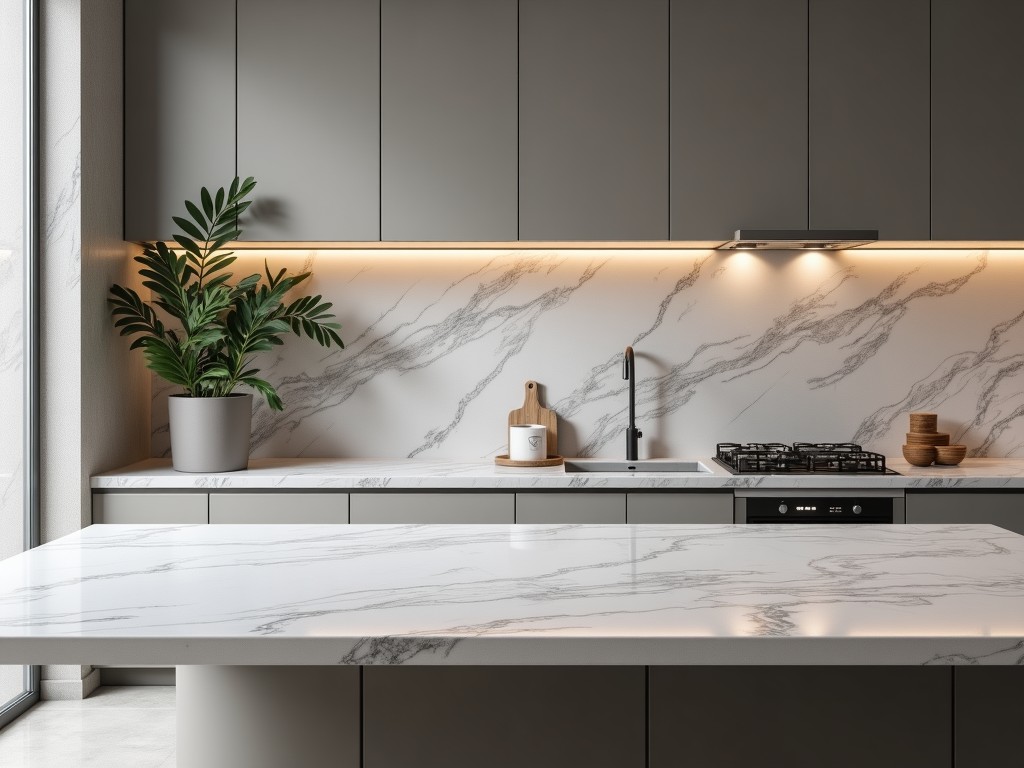
The countertop slab consists of approximately 93% natural quartz aggregate bound with polymer resins and pigments. This composition yields a non‑porous surface with water absorption below 0.02% and a
Inquire NowThe countertop slab consists of approximately 93% natural quartz aggregate bound with polymer resins and pigments. This composition yields a non‑porous surface with water absorption below 0.02% and a Mohs hardness rating of 7, providing resistance to scratching from typical kitchen utensils.
| Property | Typical Value | Test Standard |
|---|---|---|
| Density | 2.38 g/cm³ | ASTM C97 |
| Flexural Strength | 55 MPa | ASTM C880 |
| Impact Resistance (Charpy) | 4.2 J | ASTM D256 |
| Thermal Expansion Coefficient | 25 × 10⁻⁶/°C | ASTM E228 |
| Stain Resistance (Rating) | Class A (no visible stain after 24 h) | ANSI Z124.6 |
Raw quartz granules are screened to remove fines, then mixed with resin, pigments, and additives in a vacuum mixer to eliminate entrapped air. The mixture is fed into a slab press where it undergoes vibration and pressure (approximately 100 bar) at 60‑80 °C to achieve full consolidation.
After pressing, slabs are transferred to a curing oven for a controlled post‑cure cycle (90 °C for 30 minutes) to reach final polymer cross‑link density. Subsequent calibration ensures thickness tolerance of ±0.5 mm across the slab width.
Surface finishing is performed using a series of diamond abrasive pads, progressing from coarse (30 grit) to fine (3000 grit) to obtain the desired polished or honed appearance. Final inspection includes visual defect scanning and thickness verification before slab stacking.
Kitchens demand surfaces that resist frequent exposure to water, acidic substances (citric acid, vinegar), and thermal shock from hot cookware. The low water absorption and chemical inertness of the quartz‑resin matrix prevent staining and etching, while the moderate thermal expansion coefficient reduces the risk of cracking under rapid temperature changes.
Additionally, the non‑porous nature eliminates the need for sealing, simplifying maintenance routines for commercial kitchens where hygiene standards are stringent. The consistent colour and pattern across large slabs support seamless installations in island and countertop runs.
Quality assurance begins with incoming quartz aggregate testing for silica content and particle size distribution. In‑process controls monitor resin viscosity, mixer temperature, and press pressure to maintain consistent slab density.
Finished slabs undergo a standardized battery of tests: flexural strength, impact resistance, water absorption, and surface hardness. Any slab deviating from the specified tolerance range is quarantined for rework or scrap, ensuring that only material meeting the defined specifications proceeds to packaging.
Slabs are stacked on A‑frame wooden pallets with polyethylene corner protectors and secured with polyester strapping. Each pallet includes a moisture‑barrier wrap and is labelled with slab dimensions, batch number, and inspection certificate.
For export shipments, pallets are placed inside ISO‑standard containers with additional bracing to prevent movement. Lead time typically ranges from 3‑4 weeks after final drawing approval, depending on order volume and current production schedule.
Yes. We provide CNC cutting services to produce cut‑to‑size panels, islands, or backsplash pieces based on CAD files supplied by the client.
Project details such as slab thickness, edge profile, surface finish, total square metres, and delivery location enable accurate pricing and lead‑time estimation.
Each slab undergoes visual defect scanning, thickness measurement with a laser gauge, and a set of mechanical tests (flexural strength, impact) per our internal QC checklist.
Queenswood delivers modern bathroom solutions through original design, advanced manufacturing, and reliable quality for customers worldwide.


Middle of Xingang East Road, Haizhu District, Guangzhou City, Guangdong Province

