
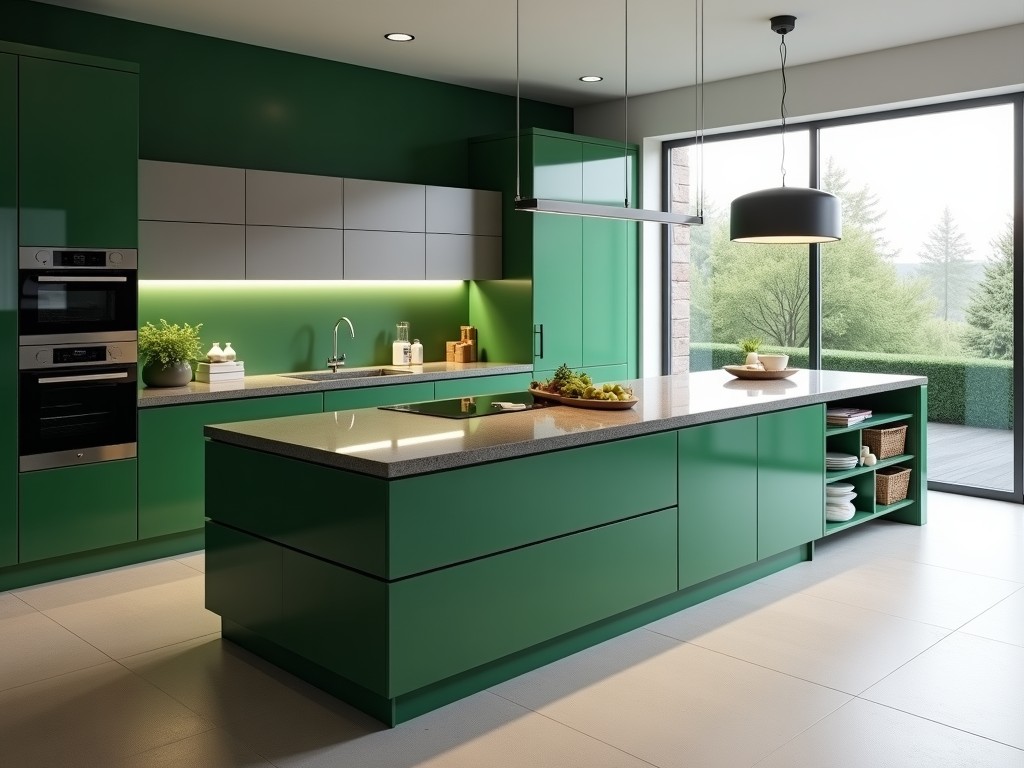
Green quartz countertops are engineered stone slabs composed primarily of natural quartz aggregates bound with polymer resins and pigmented to achieve a consistent verdant hue. This composition
Inquire NowGreen quartz countertops are engineered stone slabs composed primarily of natural quartz aggregates bound with polymer resins and pigmented to achieve a consistent verdant hue. This composition yields a non‑porous surface that resists staining, scratching, and microbial growth, making it suitable for demanding kitchen environments.
Typical slabs contain 90‑95 % ground quartz by weight, with the remaining fraction consisting of unsaturated polyester resins, UV stabilizers, and inorganic green pigments. The high quartz content contributes to a Mohs hardness of approximately 7, while the resin matrix provides flexural strength ranging from 40 to 60 MPa depending on curing conditions.
Water absorption is typically below 0.05 % after 24 h immersion, indicating excellent resistance to liquid penetration. Thermal expansion coefficients are comparable to natural granite, allowing the material to withstand rapid temperature changes without cracking when installed with proper expansion joints.
The production begins with precise weighing and mixing of quartz granules, resin, pigment, and additives in a vacuum mixer to eliminate entrapped air. The mixture is then fed into a slab press where it undergoes vibration and pressure (approximately 100 bar) to achieve dense compaction.
After pressing, the slabs are transferred to a curing oven where they are heated to 80‑90 °C for 45‑60 minutes to initiate polymer cross‑linking. Post‑curing, the slabs are calibrated to thickness (commonly 2 cm or 3 cm) and polished using a sequence of diamond abrasives to obtain the desired surface finish, ranging from matte to high gloss.
Each slab undergoes dimensional inspection with laser scanners to verify thickness tolerance (±0.1 mm) and flatness (≤0.5 mm deviation over 1 m). Visual inspection under standardized lighting detects color uniformity, surface defects, and resin streaks.
Mechanical testing includes flexural strength per ASTM C1202 and impact resistance via falling ball tests. Chemical resistance is evaluated by exposing samples to common kitchen acids (citric, acetic) and bases for 24 h, followed by visual and gravimetric analysis.
Only slabs meeting all predefined criteria are released for further processing; any non‑conforming units are re‑ground and recycled back into the raw material stream.
The non‑porous nature of green quartz prevents absorption of oils, acids, and pigments commonly found in food preparation, reducing the risk of bacterial harborage and simplifying cleaning routines. Its resistance to thermal shock allows placement of hot pots directly on the surface when combined with appropriate trivets, while the high scratch tolerance maintains aesthetic integrity over years of daily use.
Additionally, the consistent coloration eliminates the variability seen in natural stone, enabling designers to achieve uniform large‑area installations without visible seams when slabs are book‑matched or carefully aligned.
| Property | Typical Value | Test Method / Reference |
|---|---|---|
| Quartz Content (wt %) | 90‑95 | XRF analysis |
| Flexural Strength | 40‑60 MPa | ASTM C1202 |
| Water Absorption | <0.05 % | ASTM C97 |
| Mohs Hardness | ≈7 | Scratch test |
| Thermal Expansion Coefficient | 20‑25 × 10⁻⁶ /°C | ASTM E228 |
| Stain Resistance (Citric Acid 24 h) | No visible change | Internal visual assessment |
Can dimensions be customized? Yes, slabs can be cut to specific lengths, widths, and thicknesses according to project drawings; edge profiles and cut‑outs for sinks or cooktops are also available.
What information is required before quotation? Project dimensions, desired thickness, edge profile, surface finish, and any special cut‑outs or backing requirements.
What color variations are available? The base green hue can be adjusted in saturation and tone; optional veining or speckle effects can be introduced upon request.
How is quality inspected? Each slab undergoes dimensional, visual, flexural, and chemical resistance checks as outlined in our QC protocol before release.
What packaging methods are used for export? Slabs are packed in vertical A‑frames with corner protectors, wrapped in polyethylene film, and secured with steel straps; wooden crates are available for high‑value shipments.
To discuss your specific requirements, request a detailed quote, or arrange sample evaluation, please contact our technical sales team.
Contact UsQueenswood delivers modern bathroom solutions through original design, advanced manufacturing, and reliable quality for customers worldwide.


Middle of Xingang East Road, Haizhu District, Guangzhou City, Guangdong Province

