
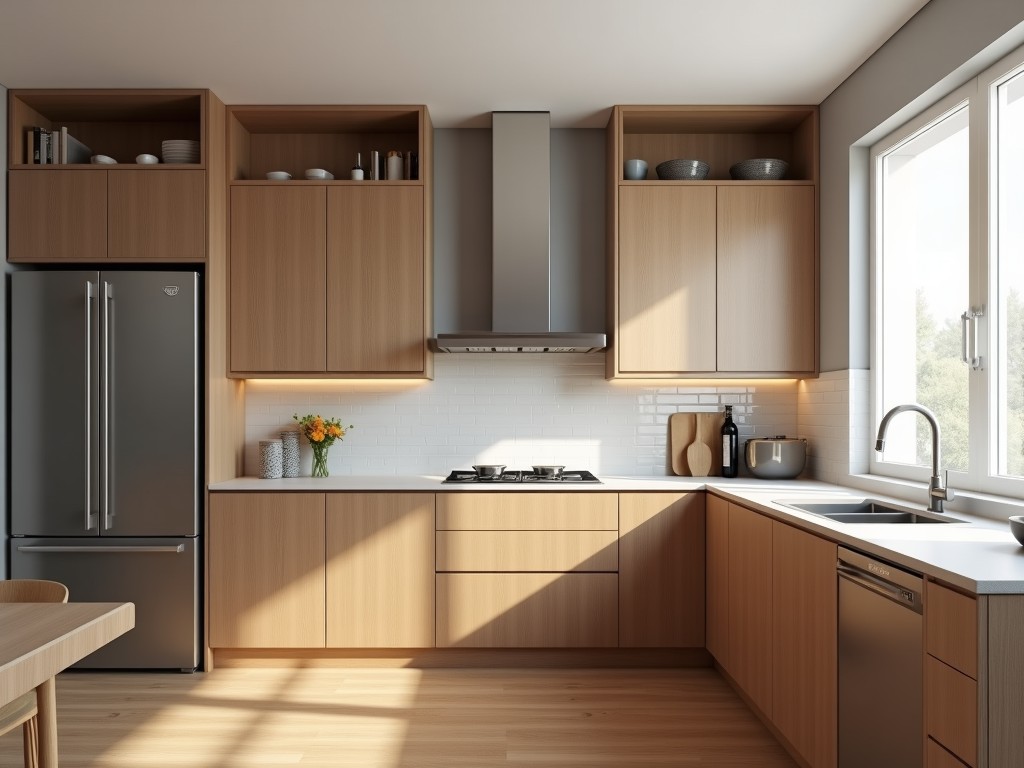
Kitchen cabinets are structural enclosures that must support static loads from countertops, appliances, and stored items while resisting humidity, temperature fluctuations, and frequent cleaning.
Inquire NowKitchen cabinets are structural enclosures that must support static loads from countertops, appliances, and stored items while resisting humidity, temperature fluctuations, and frequent cleaning. Engineers select panel materials, joinery methods, and finish systems based on calculated deflection limits, moisture‑absorption rates, and surface hardness to ensure long‑term dimensional stability.
Cabinets are built on a 100 mm modular grid, allowing width, height, and depth adjustments in 100 mm increments without redesigning structural members. Door overlay options include full‑overlay (0 mm reveal), half‑overlay (≈ 9 mm reveal), and inset (flush with frame), each affecting hinge torque requirements and clearance calculations.
Adjustable shelf systems use 5 mm diameter steel pins with a load rating of 150 N per pair, and shelf thickness is typically 18 mm particleboard with a 0.5 mm PVC edge band to prevent chipping. Drawer slides are specified by dynamic load capacity (e.g., 30 kg full‑extension) and travel tolerance (±0.2 mm).
Panel blanks are cut on CNC routers with positional accuracy ±0.1 mm, followed by automated edge‑banding using hot‑melt adhesive (peak temperature 200 °C). Pocket holes for cam locks are drilled at 8 mm diameter with a 15 mm depth tolerance, ensuring consistent clamping force. Final assembly employs pneumatic clamps applying 250 N pressure for 10 seconds to cure adhesive joints.
Dimensional inspection verifies cabinet squareness within 0.5 mm diagonal difference and face flatness under 0.3 mm deviation. Finish adhesion is measured via cross‑hatch tape test (ASTM D3359) requiring a rating of 5B. Load testing applies 200 kg static weight to the top panel for 24 hours; permissible deflection is limited to L/200 (span/200).
In residential settings, cabinets must accommodate daily opening cycles (≈ 15 cycles/day) and resist staining from food acids; therefore, a melamine‑impregnated paper finish with a Taber abrasion index < 10 mg/1000 cycles is specified. For commercial kitchens, NSF/ANSI 2 compliance is required, necessitating seamless welds on stainless steel doors and a minimum 2 mm radius on all internal corners to facilitate cleaning and prevent bacterial harborage.
| Parameter | Typical Value | Notes |
|---|---|---|
| Panel Thickness (frame) | 18 mm | Hardwood plywood, ±0.2 mm tolerance |
| Door Overlay | Full‑overlay (0 mm reveal) | Requires concealed hinge with 35 mm cup depth |
| Shelf Load Capacity | 150 N per pair of pins | 5 mm steel pins, 18 mm particleboard shelf |
| Drawer Slide Travel | Full‑extension 450 mm | Dynamic load 30 kg, travel tolerance ±0.2 mm |
| Finish Abrasion Resistance | < 10 mg/1000 cycles (Taber) | Melamine‑impregnated paper |
| Corner Radius (internal) | 2 mm | Required for NSF/ANSI 2 compliance |
Can dimensions be customized? Yes. Width, height, and depth are adjustable in 100 mm increments; special sizes require engineering review for load‑bearing capacity.
What information is needed for a quotation? Provide overall layout dimensions, material preference (e.g., plywood, MDF, stainless), door style, hardware specifications, and any required certifications (e.g., NSF, FSC).
Which materials are available for high‑moisture areas? Marine‑grade plywood (BS 1088), moisture‑resistant MDF, and 304 stainless steel are standard options.
How is quality inspected? Each unit undergoes dimensional checks (±0.5 mm), squareness test, finish adhesion (ASTM D3359), and load deflection verification before packaging.
What packaging methods protect export shipments? Cabinets are wrapped in polyethylene film, placed on corner‑protected pallets, and secured with PET straps; optional vapor‑barrier bags are available for long‑term sea freight.
To receive a detailed quote and technical datasheet, share your project requirements via the contact form. Our engineering team will review load calculations, material suitability, and lead‑time estimates before issuing a formal proposal.
Request QuoteQueenswood delivers modern bathroom solutions through original design, advanced manufacturing, and reliable quality for customers worldwide.


Middle of Xingang East Road, Haizhu District, Guangzhou City, Guangdong Province

