
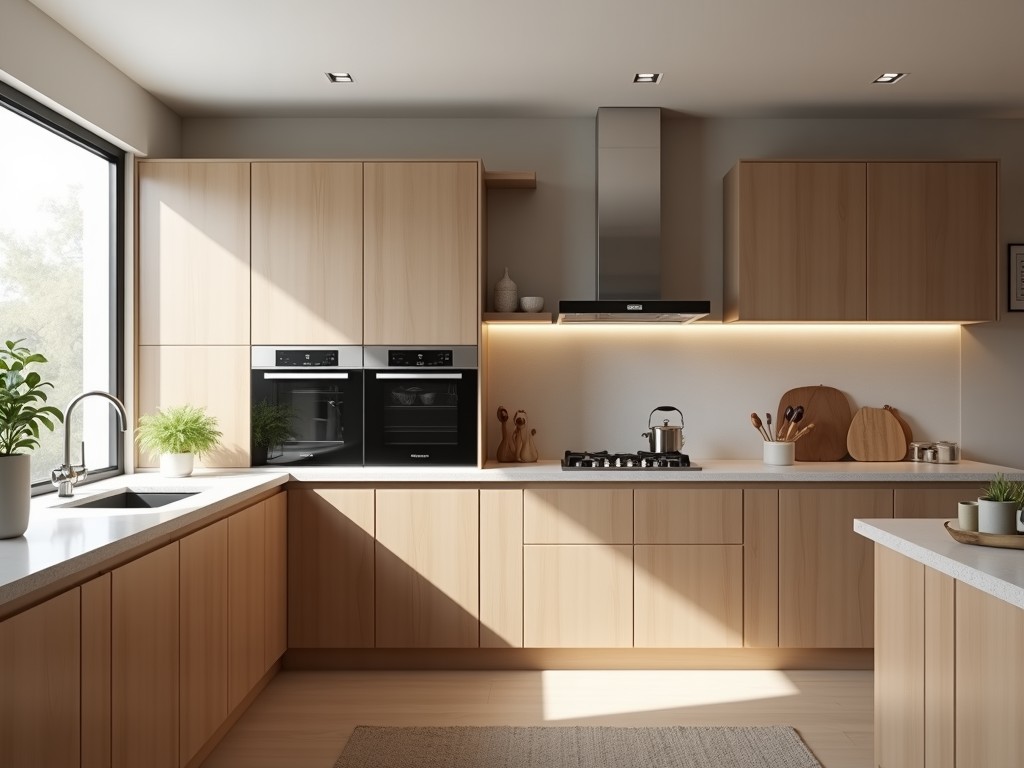
Industrial buyers seeking cabinetry for commercial kitchens, laboratory facilities, or hospitality projects require suppliers that can interpret architectural drawings, maintain tight tolerances, and
Inquire NowIndustrial buyers seeking cabinetry for commercial kitchens, laboratory facilities, or hospitality projects require suppliers that can interpret architectural drawings, maintain tight tolerances, and deliver repeatable finishes across large quantities.
The core panel determines load capacity, moisture resistance, and machining behavior. Common substrates include 18 mm particleboard with melamine overlay, 19 mm MDF with PVC edge band, and 16 mm plywood core with hardwood veneer. Each option presents distinct modulus of elasticity and swelling rates that affect joint integrity.
Cabinet durability relies on joint type and fastener selection. Dado joints reinforced with cam locks provide shear resistance >2 kN for drawer boxes, while mortise‑and‑tenon joints in frame‑and‑panel doors deliver moment capacity suitable for heavy‑duty use.
Automated CNC drilling ensures hole placement tolerance ±0.15 mm, critical for aligning concealed hinges and slide mechanisms.
Industrial projects often require cabinets to fit within modular grid systems (e.g., 300 mm increments). Maintaining width tolerance ±0.5 mm and height tolerance ±0.7 mm prevents gap accumulation across runs of ten or more units.
Adjustable shelf pins with 5 mm diameter holes allow vertical spacing changes without re‑drilling, supporting dynamic storage configurations.
Finish selection impacts chemical resistance, UV stability, and cleaning frequency. Options include:
Specifying compatible hardware early avoids field modifications. Commonly integrated items are:
Each production batch undergoes three inspection checkpoints: incoming material verification, in‑process dimensional audit, and final functional test. Material verification includes thickness measurement (±0.1 mm) and moisture content (<8 %).
In‑process audit uses a coordinate measuring machine to check cabinet squareness (diagonal deviation <0.3 mm) and alignment of pre‑drilled holes.
Final functional test cycles doors and drawers 5 000 times to verify hinge and slide endurance, recording any deviation in closing force >10 %.
Beyond residential kitchens, these cabinets serve environments where hygiene, chemical exposure, and heavy usage are concerns.
| Parameter | Standard Catalog (mm) | Custom Project (mm) |
|---|---|---|
| Material thickness options | 16 mm, 19 mm | 12 mm‑25 mm in 1 mm increments |
| Edge band types | PVC 0.5 mm, melamine | PVC, ABS, wood veneer, metal edge |
| Production lead time | 10‑15 working days | 18‑25 working days (depends on complexity) |
| Minimum order quantity | 20 units | 5 units (prototype) |
Can dimensions be customized to match existing architectural modules?
Yes. Width, height, and depth can be adjusted in 1 mm increments to align with 300 mm or 600 mm grid systems, with tolerance ±0.5 mm.
What information is required before a quotation can be issued?
Detailed drawings (plan, elevation, section), material preference, hardware specifications, finish type, and required quantity.
Which materials are available for wet‑area applications?
Marine‑grade plywood, PVC‑coated MDF, or stainless‑steel clad panels, all tested for swelling <2 % after 24 h water immersion.
How is quality inspected before shipment?
Each unit undergoes dimensional audit, finish adhesion test (cross‑hatch ASTM D3359), and functional cycle test (5 000 openings).
What packaging methods protect cabinets during export?
Flat‑packed in double‑wall corrugated boxes with corner protectors, or fully assembled units crated with ISPM‑15 compliant wood and foam edge guards.
What is the typical production lead time for a custom order?
18‑25 working days, depending on material selection and finish complexity; expedited options available upon request.
How are samples arranged for evaluation?
A single‑unit sample can be produced with the client’s chosen material and finish, shipped at cost, and credited toward the first production order.
For technical consultation or to request a detailed quote, please contact our engineering team.
Request QuoteQueenswood delivers modern bathroom solutions through original design, advanced manufacturing, and reliable quality for customers worldwide.


Middle of Xingang East Road, Haizhu District, Guangzhou City, Guangdong Province

