
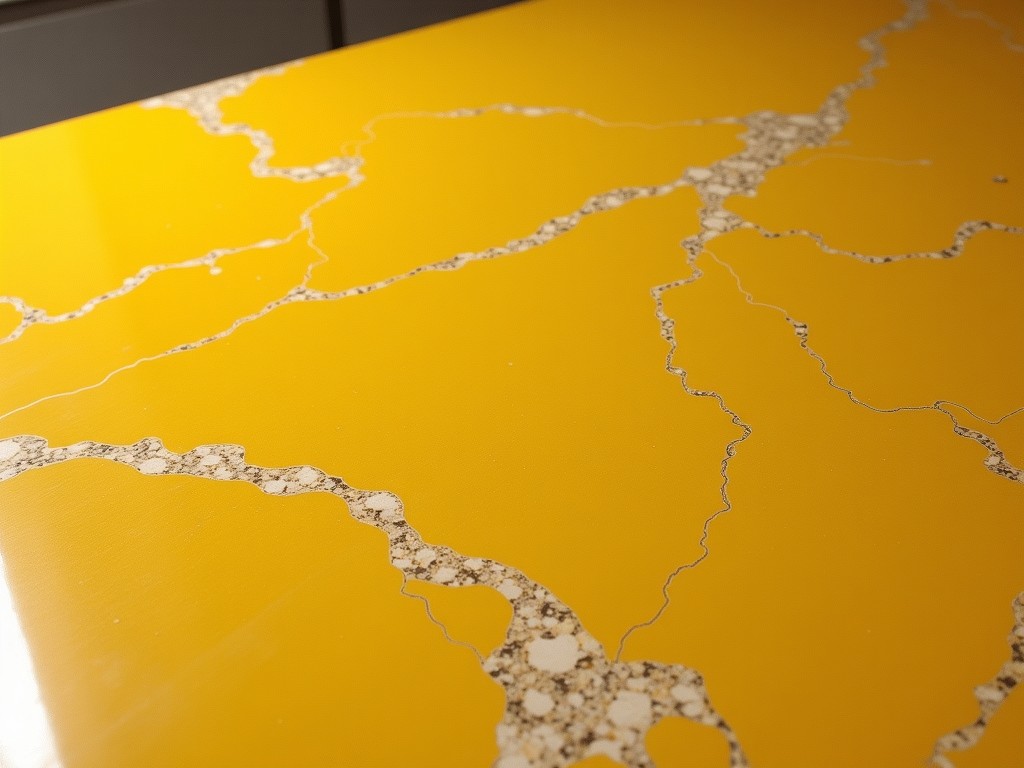
Yellow quartz countertops are engineered stone slabs composed of approximately 90 % ground natural quartz aggregate, 10 % polymer resin binder, and inorganic iron‑oxide pigments that produce the
Inquire NowYellow quartz countertops are engineered stone slabs composed of approximately 90 % ground natural quartz aggregate, 10 % polymer resin binder, and inorganic iron‑oxide pigments that produce the yellow hue. The quartz particles provide hardness and dimensional stability, while the resin matrix imparts impact resistance and enables seamless fabrication.
Typical values for factory‑produced yellow quartz slabs are: density 2.30 g/cm³, compressive strength 210 MPa, flexural strength 55 MPa, Mohs hardness 7, water absorption <0.05 % by weight, and coefficient of thermal expansion 25 × 10⁻⁶ /°C. The non‑porous surface resists staining from oils, acids, and solvents commonly encountered in industrial environments.
Countertops can be tailored to specific project requirements across several dimensions.
The slab is produced by vacuum‑vibration pressing of the quartz‑resin mixture into a mold, followed by curing in a controlled oven at 80‑100 °C for 45‑60 minutes. After demolding, the slab undergoes calibration grinding to achieve thickness tolerance, then progressive diamond polishing to the specified finish. CNC machining centers perform cut‑outs and edge profiling with positional accuracy of ±0.1 mm.
Each slab is inspected for color uniformity using spectrophotometric analysis (ΔE < 2.0), thickness variation (±0.5 mm), and flatness deviation (<0.3 mm over 1 m). Surface roughness is measured to ensure Ra < 0.2 mm for polished finishes. Automated vision systems detect inclusions, cracks, or resin streaks; any slab exceeding defined limits is reworked or rejected. Batch traceability records raw material lot numbers, curing cycle parameters, and final inspection results.
Yellow quartz countertops are selected for environments where chemical resistance, ease of cleaning, and mechanical durability are critical.
| Property | Yellow Quartz (Typical) | Standard Quartz | Granite |
|---|---|---|---|
| Density (g/cm³) | 2.30 | 2.30 | 2.65‑2.80 |
| Compressive Strength (MPa) | 210 | 200‑220 | 130‑200 |
| Water Absorption (%) | <0.05 | <0.05 | 0.1‑0.4 |
| Flexural Strength (MPa) | 55 | 50‑60 | 8‑15 |
| Mohs Hardness | 7 | 7 | 6‑7 |
Yes. Slab length, width, thickness, and cut‑out locations are produced to project‑specific tolerances. Standard maximum slab size is 3000 mm × 1400 mm; larger areas are achieved by seamless jointing with color‑matched epoxy.
To generate an accurate quote we need: overall dimensions (including edge profile), thickness, desired finish, quantity, cut‑out specifications (sink, cooktop, equipment mounts), and any special packaging or shipping requirements.
Each slab undergoes spectrophotometric color check, thickness verification, flatness measurement, surface roughness analysis, and automated vision inspection for defects. Only slabs meeting all acceptance criteria are released for packaging.
Slabs are packed in vertical A‑frame wooden crates with corner protectors, foam edge guards, and shrink‑wrap. For sea freight, crates are fitted with moisture‑barrier liners and secured with steel straps. Custom packaging (e.g., palletized, container‑specific) can be arranged upon request.
To discuss your project requirements and obtain a detailed quotation, please contact our technical sales team.
Contact UsQueenswood delivers modern bathroom solutions through original design, advanced manufacturing, and reliable quality for customers worldwide.


Middle of Xingang East Road, Haizhu District, Guangzhou City, Guangdong Province

