
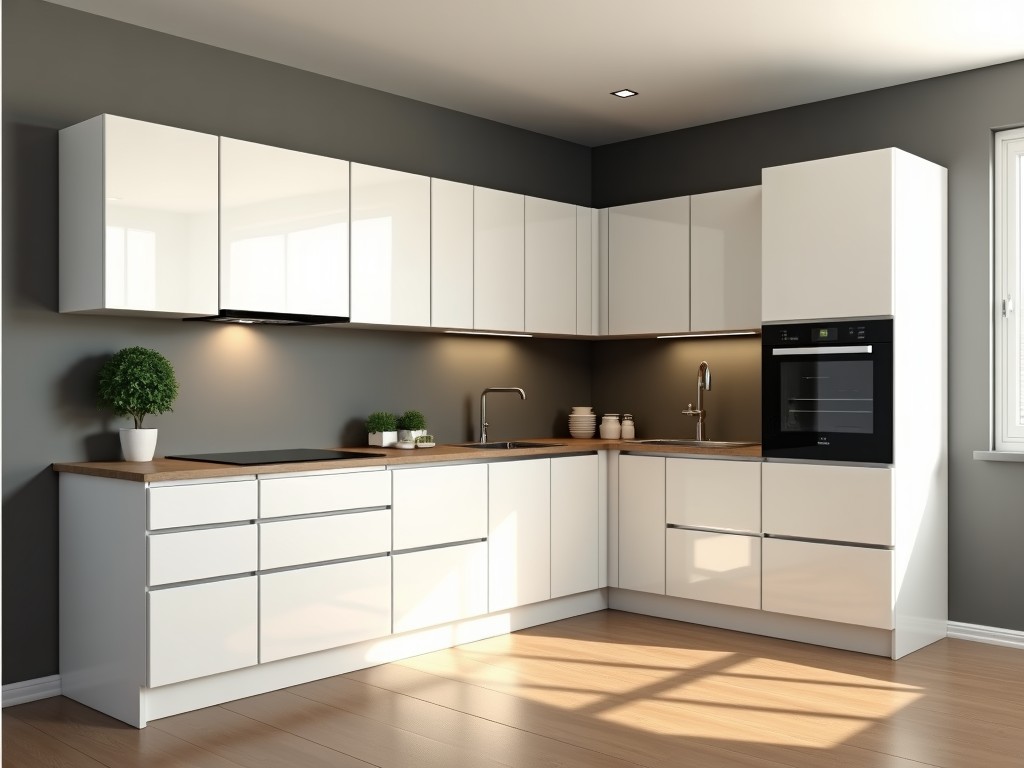
These cabinets are produced in a controlled factory environment as ready‑to‑assemble modules finished in a uniform white coating. The substrate is engineered for dimensional stability, while the
Inquire NowThese cabinets are produced in a controlled factory environment as ready‑to‑assemble modules finished in a uniform white coating. The substrate is engineered for dimensional stability, while the finish provides a clean, non‑porous surface suitable for high‑traffic kitchen environments.
Industrial buyers select factory‑made white cabinets to shorten project lead times, eliminate on‑site painting variability, and obtain repeatable quality across large volumes. The modular design allows integration with a variety of door styles, hardware systems, and interior accessories without custom fabrication delays.
Core panels are typically manufactured from CARB2‑compliant medium density fibreboard (MDF) with a density of 650‑750 kg/m³, offering consistent screw holding and machinability. For applications requiring higher moisture resistance, moisture‑resistant particleboard (MR‑PB) or multilayer plywood (birch or poplar) with a minimum 9‑ply construction can be specified.
Panel thickness options range from 16 mm for standard wall cabinets to 18‑22 mm for base units that support heavier loads. Edge sealing is applied to all cut faces using a hot‑melt polyurethane adhesive to prevent substrate swelling and maintain finish adhesion.
Cabinet boxes are produced to a nominal width increment of 100 mm, height increments of 50 mm for wall units and 100 mm for base units, with a depth of 300 mm (wall) or 560 mm (base). CNC cutting ensures dimensional tolerances of ±0.5 mm on panel lengths and ±0.2 mm on hole centres, enabling repeatable alignment of hinges, drawer slides, and mounting brackets.
Frameless (European) construction is standard, providing full‑access interior volume and eliminating the need for face‑frame machining. Optional face‑frame configurations are available upon request, with mating tolerances held to ±0.3 mm to maintain uniform reveal gaps.
The white finish is a UV‑cured polyurethane coating applied in a two‑step process: a primer layer (≈15 µm) followed by a topcoat (≈25‑30 µm). This system delivers a pencil hardness of 2H, a gloss level of 85 ± 5 % (measured at 60°), and resistance to common kitchen stains such as coffee, oil, and mild acidic solutions.
Edge banding consists of 0.4 mm thick PVC or ABS tape pre‑finished to match the cabinet colour, applied with a hot‑melt adhesive and trimmed flush. Band adhesion is tested to exceed 1.5 N/mm peel strength, ensuring durability under repeated door opening cycles.
All cabinet panels are pre‑drilled for standard 35 mm cup hinges with a centre‑to‑centre spacing of 96 mm, allowing use of concealed or exposed hinge systems. Mounting plates for drawer slides are positioned at 32 mm from the bottom interior surface, with hole tolerances of ±0.15 mm to accommodate soft‑close mechanisms rated for 30 kg dynamic load.
Optional factory‑installed accessories include pull‑out shelves, lazy Susans, and interior lighting conduits. Each accessory is secured with machine‑screw inserts (M4 or M5) torqued to 1.2 Nm, providing repeatable fastening torque across production batches.
Raw panels are cut on a 5‑axis CNC router with a positioning accuracy of 0.02 mm, followed by edge banding on a hot‑melt applicator operating at 180 °C. After banding, panels pass through a drilling station where hinge and mounting holes are produced using carbide‑tipped bits with a spindle speed of 18 000 rpm.
The coated panels then enter a UV curing tunnel with a peak intensity of 600 mW/cm², achieving full cure in under 5 seconds per pass. Final inspection includes automated vision checks for coating uniformity and manual verification of hole alignment before packing.
Dimensional verification is performed on a coordinate measuring machine (CMM) sampling 5 % of each production lot, with acceptance criteria of ±0.5 mm on overall dimensions and ±0.2 mm on critical hole locations. Finish thickness is measured using a dry film thickness gauge, targeting 38‑45 µm total coating.
Adhesion of the UV coating is assessed via a cross‑hatch test (ASTM D3359) requiring a rating of 5B. Edge band peel resistance is checked with a tensile tester at 100 mm/min, accepting values above 1.5 N/mm. All units receive a 24‑hour humidity conditioning cycle at 40 °C/90 % RH to confirm resistance to blistering or delamination.
Original equipment manufacturers (OEMs) supplying residential kitchen lines benefit from the consistent white colour, which eliminates the need for on‑site touch‑ups and ensures colour matching across multiple product ranges. The modular nature supports rapid re‑tooling for model year changes without new tooling investments.
Multi‑family developers and hospitality chains specify these cabinets for their durability in high‑humidity environments and ease of cleaning, reducing long‑term maintenance costs. Healthcare facilities also select the finish for its non‑porous surface, which meets stringent infection‑control guidelines.
| Parameter | Typical Value | Options / Notes |
|---|---|---|
| Substrate | CARB2 MDF (650‑750 kg/m³) | MR‑PB, multilayer plywood |
| Panel Thickness | 16 mm (wall), 18‑22 mm (base) | Custom thicknesses available |
| Finish Type | UV‑cured polyurethane | Matte, satin, high gloss |
| Coating Thickness | 38‑45 µm total | Measured by dry film gauge |
| Gloss Level (60°) | 85 ± 5 % | Adjustable per request |
| Edge Band | 0.4 mm PVC/ABS | Colour‑matched, pre‑finished |
| Hinge Cup Diameter | 35 mm | Soft‑close compatible |
| Tolerance (Overall) | ±0.5 mm | CNC‑cut |
| Load Rating (Drawer) | 30 kg dynamic | Full‑extension slides |
Yes. While the standard grid is 100 mm width and 50/100 mm height steps, custom panel sizes can be produced with tolerances of ±0.5 mm. Provide the exact opening dimensions and any required cut‑outs for appliances or fixtures during the quotation phase.
We need the overall cabinet layout (plan view), desired panel thickness, finish gloss level, edge band material, hardware specifications (hinge type, slide load rating), and any special cut‑outs or accessories. Supplying a CAD file (DWG or DXF) accelerates the review.
Moisture‑resistant particleboard (MR‑PB) with a minimum density of 600 kg/m³ or multilayer plywood (minimum 9‑ply, exterior glue) are offered. Both options receive the same UV‑cured white finish and are tested for swelling after 24 h immersion at 30 °C.
Units are stacked with interleaving corrugated sheets, corner protectors, and stretch‑wrapped on a pallet. The pallet is then secured with PET strapping and placed inside a double‑wall cardboard crate for LTL shipments, or loaded directly into a container with air‑bag stabilization for FCL.
To discuss your project requirements, request a sample panel, or obtain a detailed lead‑time estimate, please reach out to our engineering team.
Queenswood delivers modern bathroom solutions through original design, advanced manufacturing, and reliable quality for customers worldwide.


Middle of Xingang East Road, Haizhu District, Guangzhou City, Guangdong Province

