
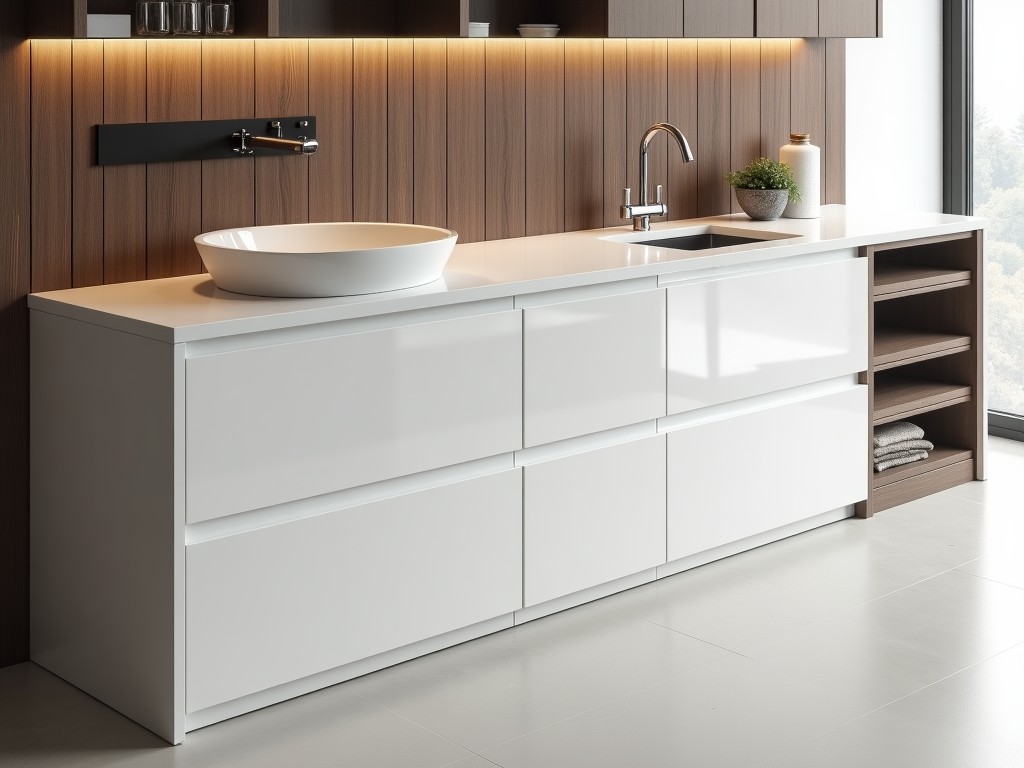
Factory‑level quartz slabs are produced under tightly controlled conditions to achieve uniform thickness, consistent resin curing, and minimal internal voids. The result is a dense, non‑porous
Inquire NowFactory‑level quartz slabs are produced under tightly controlled conditions to achieve uniform thickness, consistent resin curing, and minimal internal voids. The result is a dense, non‑porous surface that meets the dimensional stability required for high‑precision installations.
The slab consists of approximately 90‑95 % natural quartz aggregate by weight, bound with a high‑performance polyester or epoxy resin system and inorganic pigments for coloration. This high quartz content contributes to a Mohs hardness of 7 – 8 and low water absorption.
Raw quartz is screened, washed, and dried before being mixed with resin and pigments under vacuum to eliminate air entrapment. The mixture is then pressed in a vibro‑compression mold at specific pressure and temperature cycles, followed by a controlled curing cycle that ensures full cross‑linking of the resin matrix.
Slabs can be tailored to project‑specific dimensions, edge treatments, and visual patterns while maintaining the core performance characteristics of the quartz‑resin composite.
The following table lists typical values for factory‑level quartz countertops; actual values can be adjusted according to project requirements and resin formulation.
| Property | Typical Value | Test Method |
|---|---|---|
| Density | 2.35 g/cm³ | ASTM C97 |
| Compressive Strength | 180 MPa | ASTM C170 |
| Flexural Strength | 55 MPa | ASTM C880 |
| Water Absorption | <0.05 % | ASTM C97 |
| Mohs Hardness | 7‑8 | ASTM C1353 |
| Coefficient of Thermal Expansion | 25 × 10⁻⁶ /°C | ASTM E831 |
| Stain Resistance (ISO 10545‑14) | Class 5 (no visible stain) | ISO 10545‑14 |
Because of its low porosity, chemical resistance, and consistent mechanical properties, factory‑level quartz is preferred in environments where hygiene, durability, and dimensional stability are critical.
Each slab undergoes a series of inspections to verify dimensional accuracy, surface integrity, and color uniformity before leaving the factory.
Slabs are stacked on A‑frame pallets with corner protectors, interleaved with polyethylene sheets, and secured with steel straps. A moisture‑barrier wrap and UV‑stable cover protect the surface during transit.
Can dimensions be customized? Yes, slab length, width, and thickness can be adjusted to project specifications; custom sizes are subject to manufacturing constraints and may affect lead time.
What information is required before quotation? Required details include overall dimensions, desired thickness, edge profile, color or pattern reference, quantity, and delivery location.
What materials are available? Standard quartz aggregate with polyester or epoxy resin binders; alternative resin systems and specialty pigments are available upon request.
How is quality inspected? Each slab undergoes thickness, flatness, color consistency, and surface defect checks as outlined in the Quality Control section.
What packaging methods are available? Standard A‑frame pallet with corner protectors, interleaving, and stretch wrap; custom packaging (e.g., crates, foam inserts) can be arranged.
To discuss your project requirements and receive a detailed quotation, please contact our technical sales team via the link below.
Contact UsQueenswood delivers modern bathroom solutions through original design, advanced manufacturing, and reliable quality for customers worldwide.


Middle of Xingang East Road, Haizhu District, Guangzhou City, Guangdong Province

