
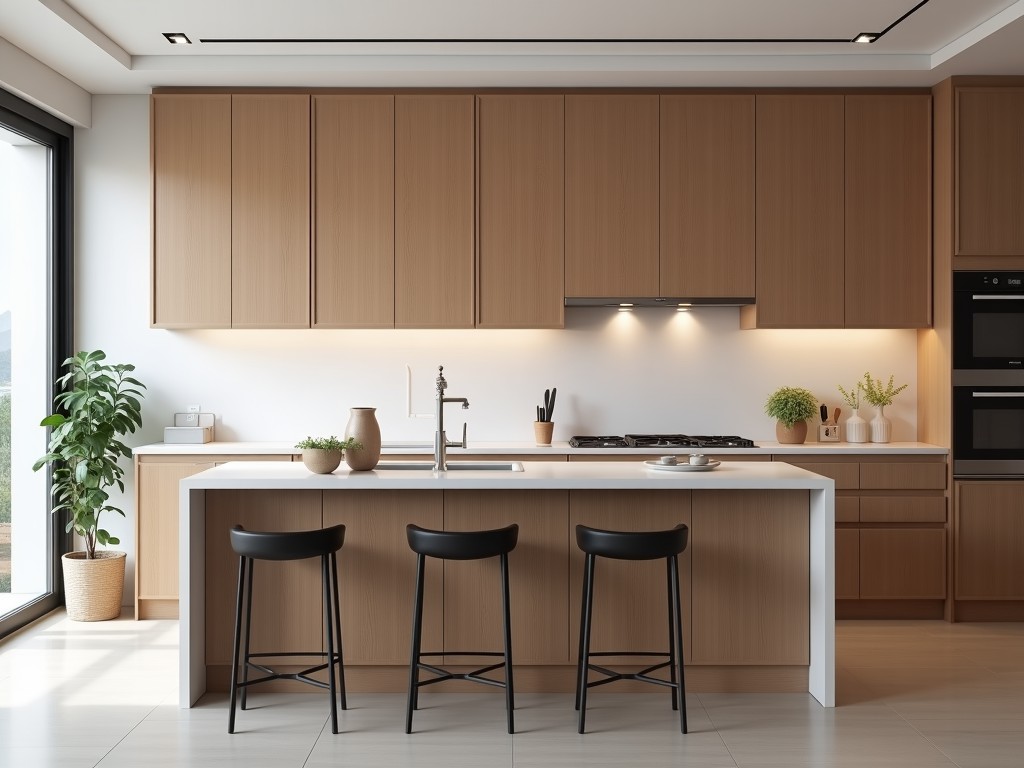
Base cabinets form the structural foundation of kitchen workspaces, supporting countertops, appliances, and storage loads. Their design must accommodate dimensional tolerances, material movement, and
Inquire NowBase cabinets form the structural foundation of kitchen workspaces, supporting countertops, appliances, and storage loads. Their design must accommodate dimensional tolerances, material movement, and fastening methods while maintaining alignment with adjacent units. This section outlines the engineering considerations that influence selection and customization.
Cabinet carcasses are typically constructed from engineered wood products or metal substrates, each offering distinct performance characteristics. The choice affects weight, moisture resistance, screw retention, and finish compatibility.
Customization extends beyond aesthetics to functional interfaces that affect installation and long‑term serviceability. The following parameters are routinely adjusted per project specifications.
| Parameter | Typical Value | Notes |
|---|---|---|
| Uniformly Distributed Load (UDL) | 150 kg per linear meter | Based on 18 mm MDF carcass with rear stretcher. |
| Screw Withdrawal Strength (face) | 800 N (MDF), 1200 N (particleboard) | Measured with #8 wood screw, 25 mm embedment. |
| Surface Finish Thickness | 0.2 mm melamine, 0.15 mm PVC foil, or 0.08 mm paint | Abrasion resistance per EN 438‑2. |
| Edge Banding | 0.5 mm PVC, 1.0 mm wood veneer, or 2.0 mm ABS | Applied with hot‑melt adhesive, peak temperature 200 °C. |
Production relies on CNC nesting for panel cutting, ensuring kerf width <0.2 mm and positional accuracy ±0.1 mm. Edge banding is applied via hot‑air rollers with pressure 0.3 MPa to achieve bond strength >1.5 MPa. Assembly utilizes cam‑lock fasteners and dowel joints, providing shear resistance suitable for the specified UDL.
Inspection occurs at three stages: incoming material verification (dimensional check, moisture content <8 %), in‑process checks (hole alignment, edge‑band adhesion), and final assembly (square tolerance <1 mm, door gap uniformity). Each cabinet undergoes a 50 kg static load test for 24 hours to confirm creep resistance.
Base cabinets are selected where load bearing, moisture exposure, and ergonomic height must align with workflow. In commercial kitchens, they support heavy equipment such as mixers and ovens, requiring resistance to vibration and thermal cycling. In residential settings, the emphasis shifts to finish durability and ease of cleaning, while still meeting the same structural criteria.
Can dimensions be customized to match non‑standard kitchen layouts?
Yes. Width, height, and depth are adjustable in 50 mm increments, and custom profiles can be engineered for corner or peninsula configurations.
What information is required before quotation?
Detailed layout drawings, material preference, finish type, hardware specifications, and any required certifications (e.g., NSF, FSC).
Which materials are available for high‑humidity environments?
MR‑grade plywood, stainless steel, or moisture‑resistant MDF with appropriate edge sealing.
How is quality inspected?
Incoming material checks, in‑process dimensional and adhesion verification, and final load and gap testing as described above.
What packaging methods are available for export shipments?
Flat‑packed in corrugated cartons with corner protectors, or fully assembled in wooden crates with foam cushioning, both conforming to ISPM‑15 standards.
What is the typical production lead time?
Standard lead time is 3‑4 weeks after drawing approval; expedited options are available upon request.
How are samples arranged?
Answer: Sample doors or full‑size cabinet sections can be shipped via express courier; charges are credited against the first order.
To begin the quotation process, provide your project specifications using the contact form below. Our engineering team will review load requirements, material constraints, and finish preferences to deliver a detailed proposal.
Queenswood delivers modern bathroom solutions through original design, advanced manufacturing, and reliable quality for customers worldwide.


Middle of Xingang East Road, Haizhu District, Guangzhou City, Guangdong Province

