
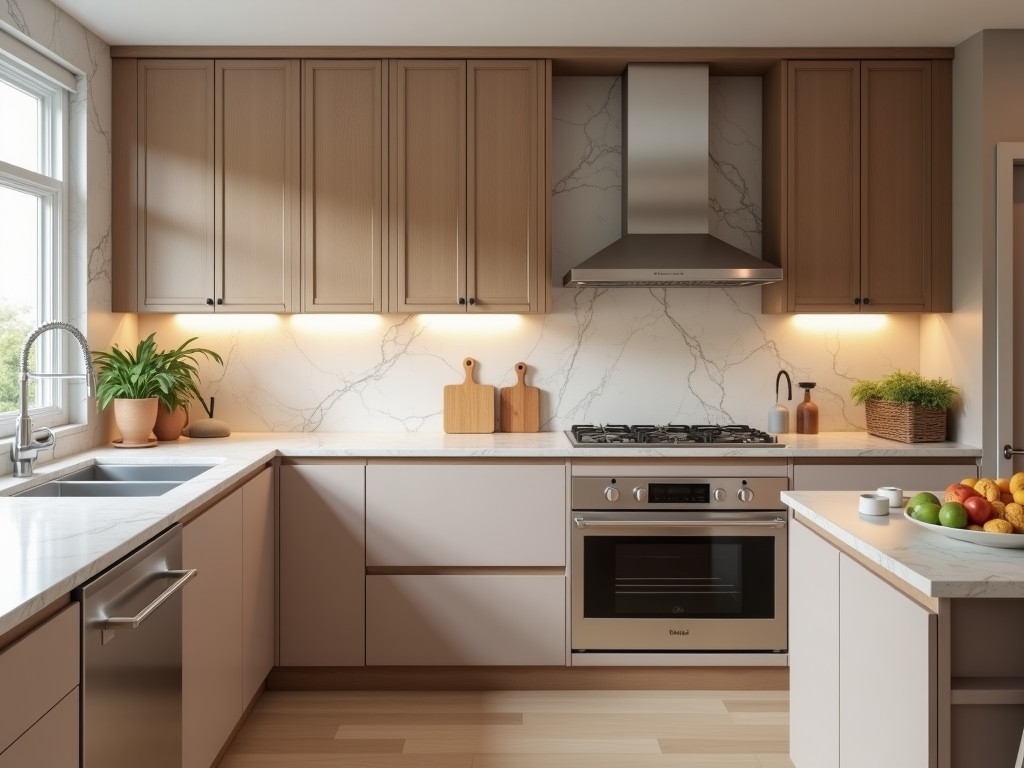
Our facility produces kitchen cabinets to exact customer specifications, using CNC machining, panel sawing, and edge banding equipment calibrated for repeatable dimensional accuracy. Each unit is
Inquire NowOur facility produces kitchen cabinets to exact customer specifications, using CNC machining, panel sawing, and edge banding equipment calibrated for repeatable dimensional accuracy. Each unit is built from sheet goods or solid wood blanks selected according to the project’s structural and finish requirements.
Material choice directly influences cabinet weight, moisture resistance, and surface durability. We stock common grades and can source specialty substrates upon request, with typical properties listed below.
Customer-provided CAD files (DWG, DXF, or SKP) are imported into our CAM system, where nesting algorithms optimize material usage to within 1‑2 % waste. Joint details such as dowel, cam lock, or confirmat are automatically generated based on load calculations for typical door weights of 4‑8 kg.
A preliminary 3D review is shared for clearance checks (e.g., appliance openings, filler strips) before toolpath generation. All critical dimensions are annotated with target tolerances, enabling the production team to verify compliance during in‑process inspection.
| Capability | Typical Value / Range |
|---|---|
| Panel cutting accuracy | ±0.2 mm on straight cuts, ±0.3 mm on contour cuts |
| Edge banding thickness | 0.4‑2.0 mm PVC, ABS, or wood veneer |
| Drill hole placement | ±0.15 mm XY, depth tolerance ±0.1 mm |
| Load‑rated shelf sag | ≤1.5 mm under 20 kg uniformly distributed load (300 mm span) |
| Standard lead time | 10‑15 working days after drawing approval (volume dependent) |
Inspection occurs at three stages: incoming material verification, in‑process dimensional checks, and final assembly audit. Each stage uses calibrated instruments traceable to national standards.
Cabinets produced here are specified for multifamily housing, hospitality suites, and high‑end residential kitchens where dimensional consistency reduces on‑site fitting time. The ability to match existing façade materials (e.g., veneer‑wrapped MDF to existing laminate) allows seamless integration during renovation without visible seams.
For laboratory or medical environments, we offer sealed edge finishes and antimicrobial coatings that meet ISO 14644‑1 Class 6 cleanliness criteria when paired with appropriate substrate selection.
Beyond standard sizes, we accommodate non‑standard angles, integrated lighting channels, and custom hardware placements. All custom features are reviewed for manufacturability before tooling is released.
| Question | Answer |
|---|---|
| Can dimensions be customized to millimeter precision? | Yes. CNC programming allows tolerance control down to ±0.1 mm for critical interfaces. |
| What information is required before quotation? | Cabinet layout drawings, material preferences, hardware specifications, and finish details. |
| Are there minimum order quantities? | No. We accept single‑unit prototypes as well as production runs. |
| How is quality inspected for shipped goods? | Final audit includes dimensional check, finish inspection, and functional hardware test; a QC sign‑off sheet accompanies each shipment. |
| What packaging methods are available for export? | Flat‑pack with corner protectors, shrink‑wrapped pallets, or custom crates upon request. |
To begin a project, please submit your CAD files, material selections, and required delivery date via our contact form. Our engineering team will review the package and return a detailed quotation within two business days.
Queenswood delivers modern bathroom solutions through original design, advanced manufacturing, and reliable quality for customers worldwide.


Middle of Xingang East Road, Haizhu District, Guangzhou City, Guangdong Province

