
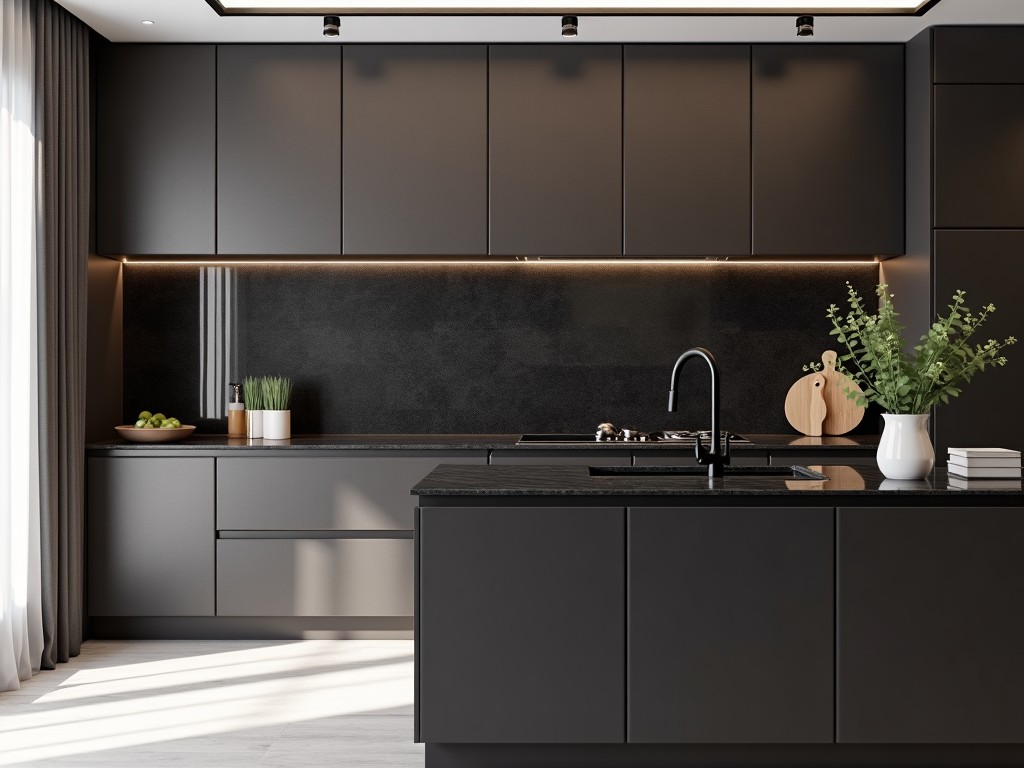
Black quartz countertops are engineered stone composites made from roughly 90‑95% milled quartz crystal, polymer resin binders, and inorganic pigments that yield a consistent, deep black surface. The
Inquire NowBlack quartz countertops are engineered stone composites made from roughly 90‑95% milled quartz crystal, polymer resin binders, and inorganic pigments that yield a consistent, deep black surface.
The quartz particles provide inherent hardness, while the resin matrix contributes flexibility and enables seamless fabrication of large sheets.
Typical mechanical values for this composite are measured per ASTM standards and reflect the balance between aggregate strength and binder toughness.
| Property | Typical Value |
|---|---|
| Compressive strength | ≈ 200 MPa |
| Flexural strength | ≈ 50 MPa |
| Mohs hardness | ≈ 7 (quartz dominated) |
| Water absorption | ≤ 0.02 % (by weight) |
| Thermal expansion coefficient | ≈ 25 × 10⁻⁶ / °C |
| Stain resistance (ISO 10545‑14) | No visible change after 24 h exposure to common kitchen agents |
These values indicate a surface that resists scratching from typical kitchen utensils, maintains dimensional stability under temperature fluctuations, and inhibits liquid penetration that could support microbial growth.
Slabs are produced in standard dimensions of 3050 mm × 1440 mm, with thickness options commonly offered at 20 mm, 30 mm, and 40 mm to suit different load‑bearing and edge‑profile requirements.
Computer‑numerical‑control (CNC) cutting enables precise internal cutouts for sinks, faucets, and appliances, while edge‑forming tools can produce profiles such as eased, beveled, bullnose, or ogee with tolerances typically within ±0.5 mm.
Backsplashes, integrated drainboards, and matching island tops can be fabricated from the same slab to maintain visual continuity and minimize joint lines.
All custom features are defined in the shop drawing package and verified against the nominal slab size before cutting begins.
The non‑porous nature of quartz resin composites prevents absorption of oils, acids, and pigments commonly found in food processing, reducing the risk of staining and bacterial harborage.
High compressive strength supports heavy equipment such as commercial mixers, slicers, and steam tables without cracking or delamination.
Thermal stability allows brief contact with hot pans (up to ≈ 150 °C) without surface damage, while the low thermal expansion minimizes stress‑induced cracking during rapid temperature changes.
These performance attributes translate into lower maintenance cycles, reduced replacement frequency, and improved hygiene compliance.
Each slab undergoes dimensional verification using laser scanners to confirm thickness uniformity and flatness within ±0.1 mm across the full panel.
Surface inspection is performed under standardized lighting to detect inclusions, resin streaks, or pigment inconsistencies; any defect exceeding 0.5 mm in depth or length triggers rework or rejection.
Resin cure is assessed via differential scanning calorimetry (DSC) to ensure the glass transition temperature falls within the specified range, indicating adequate cross‑linkage for mechanical performance.
Final random sampling includes abrasion resistance (ASTM C418) and impact resistance (ASTM D256) checks to validate batch‑to‑batch consistency.
Finished countertops are protected with a low‑tack polyethylene film on the polished face, followed by corner protectors made of recycled foam.
Slabs are stacked vertically on wooden pallets rated for the slab weight, with steel straps securing the load and preventing movement during transit.
For export shipments, moisture‑barrier liners and ISPM‑15 compliant crating are available upon request to meet international phytosanitary standards.
To discuss specific project dimensions, edge profiles, or lead‑time requirements, please reach out to our technical sales team.
Request a QuoteQueenswood delivers modern bathroom solutions through original design, advanced manufacturing, and reliable quality for customers worldwide.


Middle of Xingang East Road, Haizhu District, Guangzhou City, Guangdong Province

