
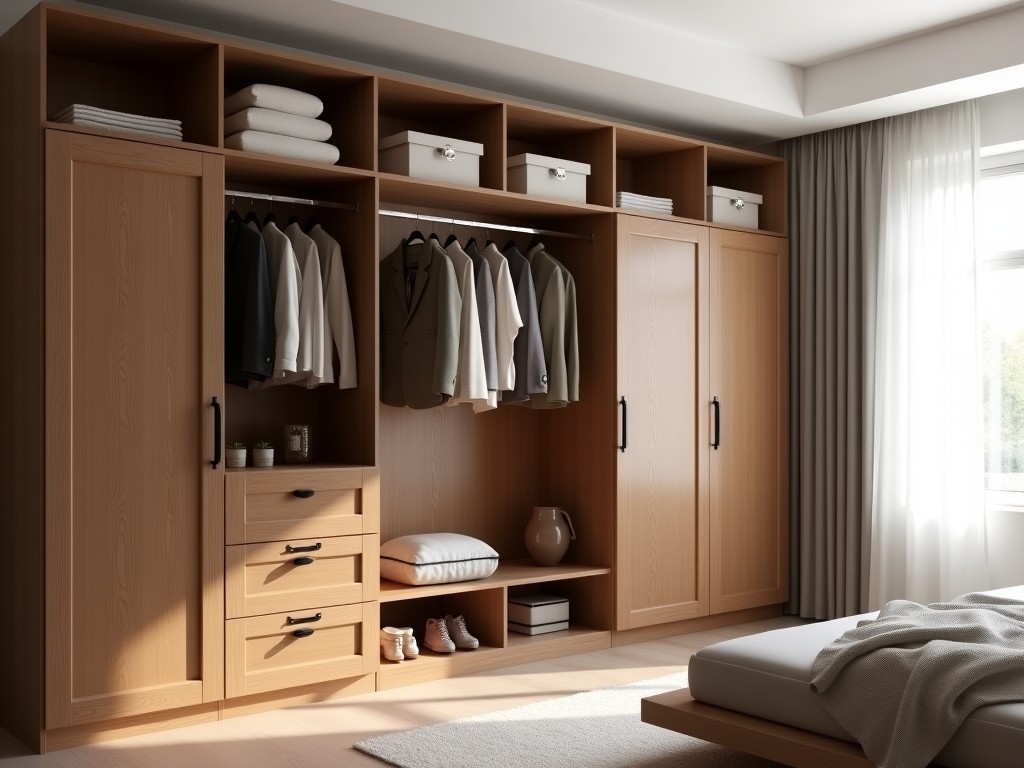
These systems are modular storage solutions engineered to meet the specific dimensional and load requirements of industrial facilities while maintaining a low unit cost. Designers define panel sizes,
Inquire NowThese systems are modular storage solutions engineered to meet the specific dimensional and load requirements of industrial facilities while maintaining a low unit cost. Designers define panel sizes, shelf depths, and hanging rod capacities based on the stored items’ weight and volume. The result is a reconfigurable closet that can be installed, adjusted, or expanded without extensive downtime.
Design begins with a load analysis that calculates the maximum uniform distributed load per shelf, typically ranging from 80 kg to 200 kg depending on the application. Deflection limits are set to L/200 to ensure shelving remains level under full load.
A parametric grid guides the placement of vertical uprights, horizontal rails, and shelf brackets, allowing incremental adjustments in 25 mm increments. This approach minimizes part count while providing the flexibility to accommodate future changes in storage geometry.
Primary structural members are formed from cold‑rolled steel with thicknesses between 0.8 mm and 1.2 mm, providing a minimum yield strength of 250 MPa and a tensile strength of 380 MPa. For environments requiring reduced weight or corrosion resistance, 6063‑T5 aluminum extrusions (tensile strength ≈200 MPa) are used for uprights and shelf supports.
Shelf panels are typically manufactured from melamine‑faced particleboard with a density of 650 kg/m³ and a modulus of elasticity around 3.5 GPa, offering a smooth surface that resists light impact. Optional stainless‑steel (grade 304) panels are available for wash‑down areas, providing a corrosion rate of less than 0.02 mm/year in salt spray testing.
Cutting and punching of steel uprights and rails are performed on CNC turret presses with positional accuracy of ±0.1 mm, ensuring hole patterns align for repeatable assembly. Laser cutting is used for complex geometries on aluminum components, maintaining kerf width under 0.2 mm.
After forming, parts undergo a multi‑stage pretreatment (degreasing, phosphating) before electrostatic powder coating, which yields a film thickness of 60 µm–80 µm with a pencil hardness of H‑2. Final assembly employs self‑clinching fasteners and snap‑fit brackets, allowing tools‑free reconfiguration in under five minutes per module.
Dimensional verification is conducted on a coordinate‑measuring machine (CMM) with a tolerance of ±0.5 mm for critical hole centers and overall length. Each shelf is subjected to a static load test where a uniformly distributed weight of 150 kg is applied for 10 minutes; residual deflection must remain below 2 mm.
Finish adhesion is evaluated per ASTM D3359 (tape test) requiring a rating of 5B or better. Corrosion resistance is validated by salt spray exposure (ASTM B117) for 500 hours with no red rust visible on coated steel surfaces.
In high‑density warehouses, these closet systems organize picking totes and small parts, reducing travel time by keeping frequently accessed items within arm’s reach. The adjustable shelving accommodates varying SKU heights without requiring permanent rework.
Garment manufacturing facilities use the hanging rod configurations to store work‑in‑progress apparel, allowing quick changeover between styles while maintaining a clean, lint‑free environment. The smooth, non‑porous surfaces facilitate routine cleaning and help meet ISO 14644‑1 cleanliness standards when paired with appropriate airflow controls.
| Parameter | Typical Value | Customizable Range / Notes |
|---|---|---|
| Overall Height | 2000 mm | 1500 mm–2500 mm (module stacking) |
| Shelf Depth | 400 mm | 300 mm, 400 mm, 500 mm, 600 mm |
| Hanging Rod Diameter | 32 mm | 25 mm, 32 mm, 38 mm (steel/aluminum) |
| Panel Thickness | 0.9 mm (steel) | 0.8 mm–1.2 mm (steel), 1.2 mm–2.0 mm (aluminum) |
| Load Capacity per Shelf | 150 kg (UDL) | 80 kg–250 kg depending on material and span |
| Finish Type | Powder coating (RAL 7035) | Any RAL, anodized, melamine laminate, stainless steel |
| Corrosion Resistance (Salt Spray) | 500 hours (no red rust) | Up to 1000 hours available with premium coating |
| Dimensional Tolerance | ±0.5 mm (critical features) | Tighter tolerances (±0.2 mm) available upon request |
Q: Can dimensions be customized to fit existing wall studs or ceiling heights?
A: Yes. Uprights can be cut to any length between 1500 mm and 2500 mm, and shelf bracket positions are adjustable in 25 mm increments to align with stud spacing or soffit obstacles.
Q: What information is required before a quotation can be issued?
A: We need a sketch or CAD layout showing desired width, height, and depth, the intended load per shelf, and any finish or accessory preferences. Environmental factors (e.g., humidity, wash‑down) help us select appropriate materials.
Q: Which material options are available for corrosive or wash‑down areas?
A: For wash‑down zones we recommend 304 stainless steel panels with a passivated finish, or aluminum extrusions with an anodic coating of ≥15 µm. Both options survive >1000 hours salt spray with no visible corrosion.
Q: How is quality inspected before shipment?
A: Each lot undergoes dimensional CMM checks, load testing of a random sample of shelves, adhesion tape tests, and a visual inspection for coating uniformity. Documentation of these tests is included with the shipment.
Q: What is the typical production lead time?
A: For standard powder‑coated steel units, lead time is 3–4 weeks after drawing approval. Custom finishes or stainless steel may extend lead time to 5–6 weeks.
Queenswood delivers modern bathroom solutions through original design, advanced manufacturing, and reliable quality for customers worldwide.


Middle of Xingang East Road, Haizhu District, Guangzhou City, Guangdong Province

