
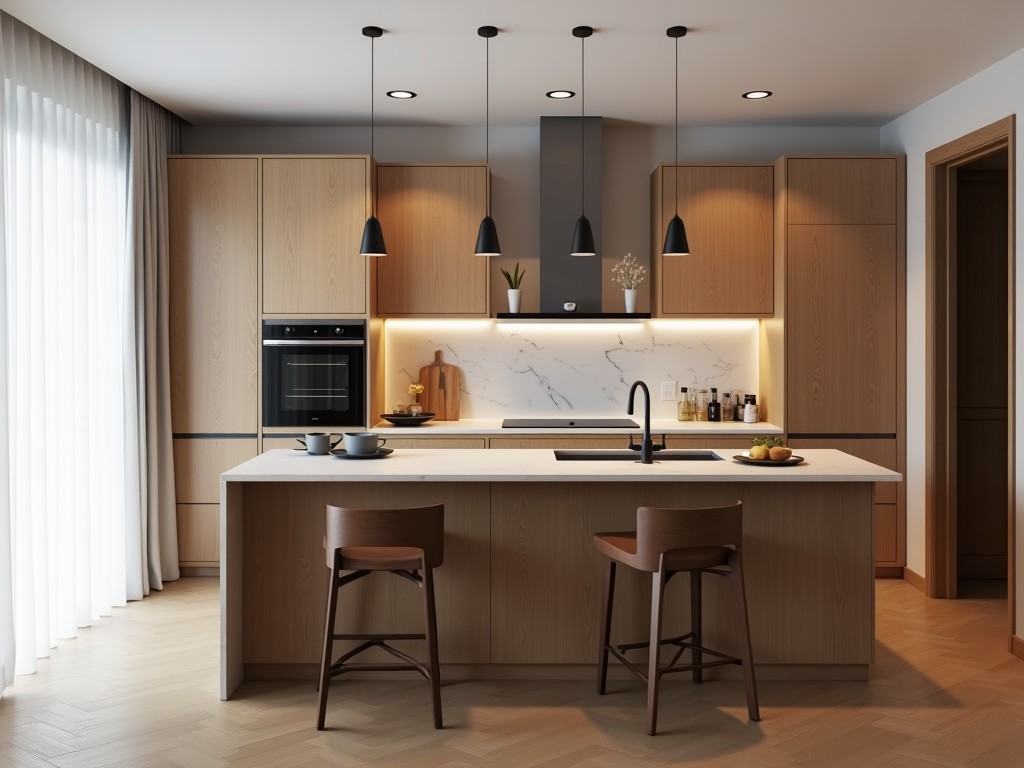
These cabinets combine frameless construction with minimalist door profiles to meet modern kitchen layouts that prioritize clean lines and efficient storage. The design accommodates integrated
Inquire NowThese cabinets combine frameless construction with minimalist door profiles to meet modern kitchen layouts that prioritize clean lines and efficient storage. The design accommodates integrated appliances, concealed hardware, and ergonomic workflow zones while maintaining structural stability under daily use.
Substrate options include 18 mm thick particleboard with a density of 650 kg/m³, medium‑density fibreboard (MDF) at 720 kg/m³, and multi‑ply plywood with cross‑banded veneers. Each material is kiln‑dried to a moisture content below 8 % to limit seasonal movement in humid environments.
Edge protection is applied using 0.5 mm PVC or ABS banding, bonded with hot‑melt adhesive that exceeds 2.0 MPa peel strength, ensuring resistance to impact and moisture ingress at the panel edges.
Panels are joined using cam‑lock fasteners combined with dowel reinforcement, providing a shear capacity of approximately 1.5 kN per joint. Dado grooves are routed for shelf placement, allowing load distribution across the panel width without reliance on surface adhesives.
Corner bracing employs metal brackets with a thickness of 2 mm, pre‑drilled for screw insertion, delivering a moment resistance of 12 Nm under typical cabinet loading conditions.
Cabinet boxes are produced in 50 mm increments for width, height, and depth, enabling precise alignment with wall studs and appliance cutouts. Frameless construction eliminates a face frame, providing full‑access interior clearance equal to the nominal opening dimensions.
Adjustable shelving uses 3 mm diameter steel pins inserted into pre‑drilled 5 mm holes, allowing vertical repositioning in 25 mm steps while supporting a uniform load of up to 150 N per shelf.
High‑pressure laminate (HPL) sheets of 0.8 mm thickness are bonded to the substrate using contact adhesive, delivering a surface abrasion rating of 150 cycles under Taber testing. Alternative finishes include 0.3 mm wood veneer sealed with UV‑cured acrylic lacquer, achieving a gloss level of 30 ± 5 GU.
For environments requiring chemical resistance, a two‑component polyurethane coating of 60 µm dry film thickness is applied, providing resistance to common kitchen solvents such as ethanol and citric acid at 20 % concentration for 24 hour exposure.
Concealed hinges are selected with a 110 ° opening angle, featuring soft‑close dampers rated for 50 000 cycles. Mounting plates incorporate slotted holes allowing ±2 mm horizontal adjustment to compensate for wall irregularities.
Drawer systems utilize full‑extension ball‑bearing slides with a load capacity of 30 kg per pair, equipped with anti‑tilt mechanisms that prevent front‑panel drop when the drawer is opened beyond 90 %.
CNC routers cut panels to ±0.2 mm tolerance using 6 mm carbide bits, followed by automated edge‑banding machines that apply adhesive at 180 °C and pressure of 0.8 MPa. Drilling stations locate hinge and shelf holes with positional accuracy of ±0.15 mm.
After assembly, each unit undergoes a 30‑second vibration test at 2 Hz to verify joint integrity before moving to finishing lines where coating thickness is measured via dry‑film gauge with a resolution of 1 µm.
Dimensional inspections verify that cabinet height, width, and depth remain within ±0.5 mm of the specified size across a sample of 5 % of production. Surface defect assessment follows a 10 point scale, accepting only units with no visible scratches deeper than 0.1 mm.
Adhesion of edge banding is tested using a peel‑off method; a minimum force of 1.8 N/mm is required to pass. Final audit includes functional operation of hinges and slides, confirming smooth movement without binding over three full cycles.
In multifamily housing, the cabinets’ resistance to humidity fluctuations—maintaining dimensional change below 0.3 % after 48 hours at 80 % RH—reduces warranty claims related to swelling or joint loosening. The frameless layout maximizes usable interior volume, a critical factor in compact urban kitchens where every centimeter counts.
For hospitality projects, the ability to specify marine‑grade plywood substrates with a salt‑spray resistance rating of 500 hours ensures longevity in coastal resorts. Integrated LED channels can be routed into the cabinet interior, providing uniform illumination with power consumption under 5 W per linear meter.
| Property | Typical Value |
|---|---|
| Panel Thickness | 18 mm |
| Substrate Density (Particleboard) | 650 kg/m³ |
| Moisture Content (max) | 8 % |
| Hinge Cycle Rating | 50 000 cycles |
| Drawer Slide Load Capacity | 30 kg per pair |
To discuss project‑specific requirements, provide your layout drawings, material preferences, and hardware specifications. Our engineering team will review the details and return a detailed proposal within three business days.
Queenswood delivers modern bathroom solutions through original design, advanced manufacturing, and reliable quality for customers worldwide.


Middle of Xingang East Road, Haizhu District, Guangzhou City, Guangdong Province

