
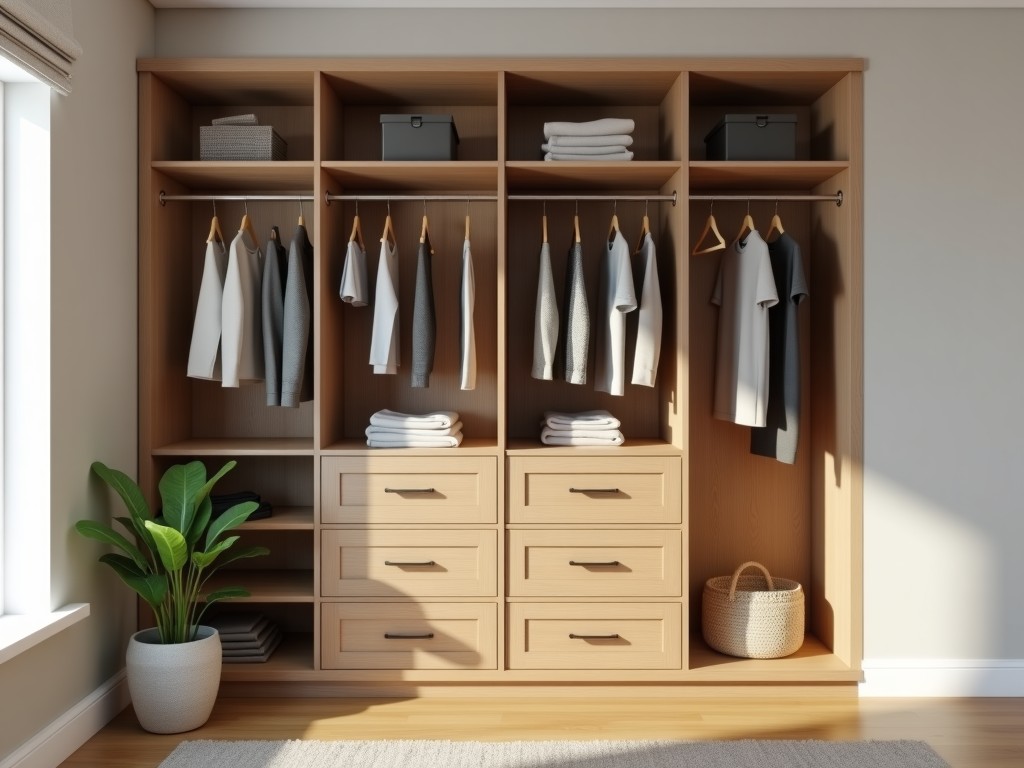
These systems are engineered to support vertical storage loads while maintaining precise dimensional stability across repeated installation cycles. Design begins with analyzing expected load
Inquire NowThese systems are engineered to support vertical storage loads while maintaining precise dimensional stability across repeated installation cycles. Design begins with analyzing expected load distribution, access frequency, and environmental conditions such as humidity or temperature variation. The result is a modular framework that can be adapted to specific spatial constraints without compromising structural integrity.
Load paths are directed through primary vertical members to secondary horizontal shelves, minimizing bending moments on connectors. Shelf spacing is calculated based on item height categories, typically ranging from 300 mm for folded garments to 500 mm for bulk storage. Connection hardware uses shear‑rated fasteners to prevent creep under sustained loads.
Modularity is achieved through standardized mounting slots spaced at 25 mm increments, allowing reconfiguration without drilling new holes. Tolerance slots accommodate thermal expansion of up to 0.5 mm per meter in aluminum components. The design incorporates a safety factor of 1.5 for static loads and 2.0 for dynamic impacts.
Primary structural members are available in cold‑rolled steel (grade DC01) with a yield strength of 210 MPa, or extruded aluminum alloy 6063‑T5 with a yield strength of 140 MPa. Steel offers higher stiffness per unit weight, while aluminum provides corrosion resistance in humid environments. Both materials receive a pretreatment phosphate coating before finishing.
Shelf panels can be fabricated from melamine‑faced particleboard (density 650 kg/m³), tempered glass (thickness 8 mm), or stainless‑steel perforated sheet (open area 30 %). Edge banding options include PVC or ABS to mitigate moisture ingress. Finish choices consist of powder coating (thickness 60‑80 µm) in RAL colors or anodized layers (15 µm) for aluminum.
Standard shelf spans of 900 mm support uniformly distributed loads up to 150 kg when constructed from steel with a 2 mm thick vertical member. Aluminum equivalents of the same geometry sustain 100 kg under the same conditions. Deflection limits are set to L/200, resulting in maximum sag of 4.5 mm for a 900 mm span.
Point loads from heavy items are accommodated by reinforcing brackets that increase local moment of inertia by 40 %. Finite element analysis confirms stress concentrations remain below 80 % of material yield under worst‑case loading scenarios. Creep testing over 1 000 hours shows less than 0.2 % deformation for steel components at 40 °C.
Cutting of steel and aluminum profiles is performed on CNC saws with positional accuracy ±0.1 mm. Hole patterns for connectors are drilled using multi‑spindle units ensuring perpendicularity within 0.2°. Bending operations employ press brakes equipped with back‑gauges to achieve bend radii consistent with design specifications.
Surface preparation includes degreasing, phosphating, and rinsing before powder coating application in a controlled booth with particle size distribution 10‑30 µm. Curing occurs at 180 °C for 20 minutes, yielding a coating hardness of 2H per pencil test. Anodizing lines maintain bath temperature at 20 ± 2 °C and current density of 1.5 A/dm².
Incoming material is inspected for thickness tolerance (±0.05 mm) and hardness (Rockwell B 70 ± 5 for steel). Dimensional verification of cut parts uses coordinate measuring machines with repeatability ±0.02 mm. Welded joints, where applicable, undergo ultrasonic testing to detect internal discontinuities.
Finished assemblies are subjected to a 24‑hour static load test at 125 % of rated capacity. Deflection is measured with dial indicators and must remain within prescribed limits. Visual inspection checks for coating uniformity, adhesion (cross‑hatch test rating 5B), and absence of sharp edges. All test results are recorded and traceable to batch numbers.
In residential high‑density developments, these organizers maximize usable closet volume by enabling double‑hang configurations and adjustable shelving, reducing the need for supplemental furniture. The modular nature allows quick reconfiguration as household storage needs evolve over years.
Hospitality installations benefit from corrosion‑resistant finishes and easy‑clean surfaces, meeting stringent hygiene standards while supporting luggage and linen storage. The design’s tolerance to frequent loading cycles minimizes maintenance interventions over the product lifecycle.| Parameter | Typical Value | Customizable |
|---|---|---|
| Overall Height (mm) | 2100 | Yes, 1800‑2600 |
| Module Width (mm) | 600 | Yes, 300‑900 |
| Shelf Depth (mm) | 500 | Yes, 300‑600 |
| Uniform Load Capacity (kg) | 150 (steel) | Dependent on material & span |
| Finish Thickness (µm) | 70 (powder) | Yes, 40‑120 |
| Deflection Limit (mm) | 4.5 (L/200) | No, design constraint |
To discuss your specific storage requirements and receive a detailed quotation, please contact our engineering team.
Request a QuoteQueenswood delivers modern bathroom solutions through original design, advanced manufacturing, and reliable quality for customers worldwide.


Middle of Xingang East Road, Haizhu District, Guangzhou City, Guangdong Province

