
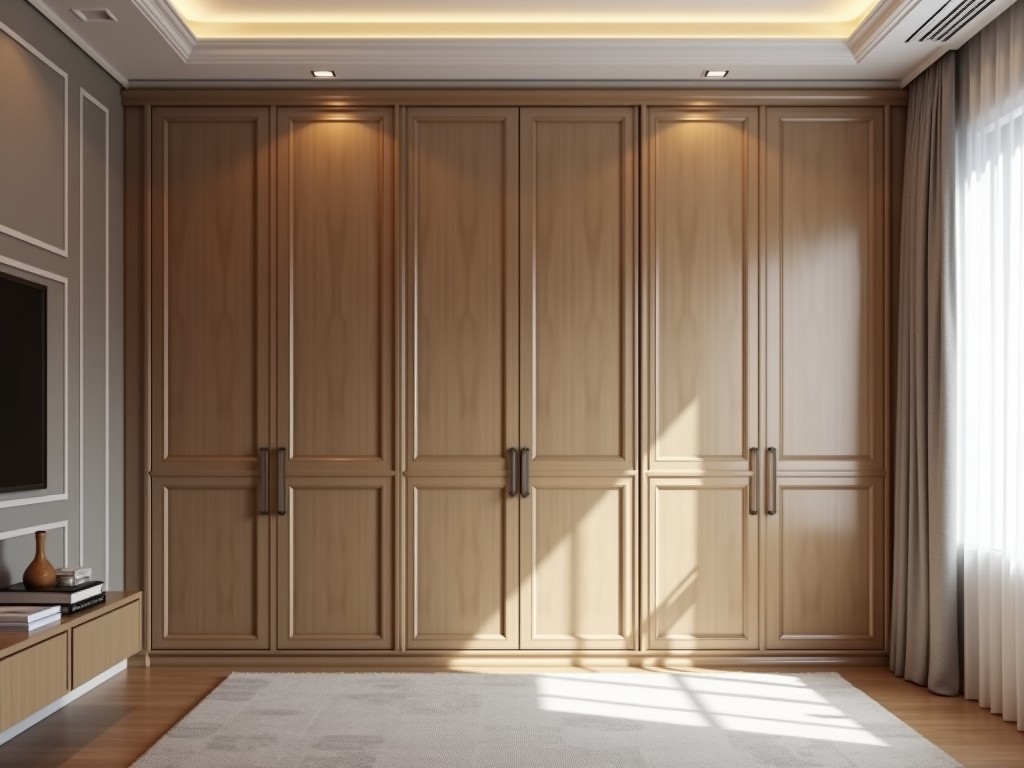
The price of a custom built wardrobe is determined by a combination of geometric specifications, material selections, hardware choices, surface treatments, and production volume. Understanding each
Inquire NowThe price of a custom built wardrobe is determined by a combination of geometric specifications, material selections, hardware choices, surface treatments, and production volume. Understanding each cost driver enables engineers and procurement specialists to evaluate quotes accurately and avoid unexpected expenses.
Overall dimensions (height, width, depth) directly affect panel area and therefore material usage. Internal layout choices such as number of shelves, hanging rails, drawers, and accessory compartments increase cut‑list complexity and machining time.
Door type influences both material and hardware costs: hinged doors require hinges and clearance space, while sliding doors need tracks, rollers, and often thicker panels to resist deflection.
Panel substrates commonly include particleboard, medium‑density fibreboard (MDF), plywood, and solid wood. Particleboard offers the lowest material cost per square metre but has lower screw‑holding strength; MDF provides a uniform surface for laminates at a moderate price; plywood adds dimensional stability for tall units; solid wood carries a premium due to material cost and finishing labor.
Surface finishes range from melamine laminate (low cost, good abrasion resistance) to wood veneer (higher material cost, requires sealing) and painted finishes (additional labor for priming and top‑coat). Hardware items such as soft‑close hinges, ball‑bearing drawer slides, and aluminium handles each add a discrete cost increment based on load rating and finish.
After finalising the CAD model, panels are cut on CNC routers with a typical tolerance of ±0.2 mm. Edge banding is applied using hot‑melt adhesive to seal exposed cores, followed by trimming and buffing.
Assembly involves drilling for cam locks, confirmit fasteners, or dowels, then installing hinges, slides, and accessories. Finishing steps may include UV curing for lacquers or sanding between coats for paint. Each stage is logged for traceability.
| Cost Component | Description | Typical Share of Total Cost |
|---|---|---|
| Raw Panels | Substrate material (particleboard, MDF, etc.) | 35‑45 % |
| Finishes & Lamination | Melamine, veneer, paint, UV coating | 15‑25 % |
| Hardware | Hinges, slides, handles, locks | 10‑20 % |
| Labor & Machining | CNC cutting, edge banding, assembly, finishing | 20‑30 % |
| Overhead & Logistics | Factory utilities, packaging, shipping to port | 5‑10 % |
Bespoke dimensions that exceed standard sheet sizes may require panel joining, increasing both material waste and seam‑finishing labor. Integrated features such as LED lighting, power outlets, or internal organizers add wiring, conduit, and additional components.
Special finishes like high‑gloss lacquer or textured wood grain necessitate extra sanding and coating cycles, which can extend production lead time by 3‑5 working days per finish layer. Lead time is therefore quoted as a base period (typically 10‑15 days for standard configurations) plus additive days for each custom element.
Dimensional checks are performed after cutting (±0.2 mm) and after assembly (±0.5 mm overall squareness). Surface finish is inspected for gloss uniformity (measured at 60°) and adhesion resistance (cross‑cut test per ASTM D3359).
Hardware functionality is verified through cycle testing: hinges are operated 20,000 cycles, drawer slides 10,000 cycles with full load. Any deviation beyond manufacturer‑specified tolerances triggers rework or scrap.
Custom wardrobes are frequently specified for employee changing rooms in manufacturing plants where durability, ease of cleaning, and compliance with hygiene standards are required. The ability to match corporate colour codes through specific laminate finishes supports brand consistency across facilities.
In retail environments, built‑in wardrobes provide secure storage for staff uniforms while integrating with shop‑fit joinery. Hospitality projects use them in guest suites to offer tailored storage solutions that maximize limited floor area without compromising aesthetics.
To obtain a detailed cost breakdown, please submit the following information: overall wardrobe dimensions, internal layout diagram, door style, selected panel substrate, finish type, hardware preferences, and required quantity. Our engineering team will review the package and return a itemized quotation within two business days.
Queenswood delivers modern bathroom solutions through original design, advanced manufacturing, and reliable quality for customers worldwide.


Middle of Xingang East Road, Haizhu District, Guangzhou City, Guangdong Province

