
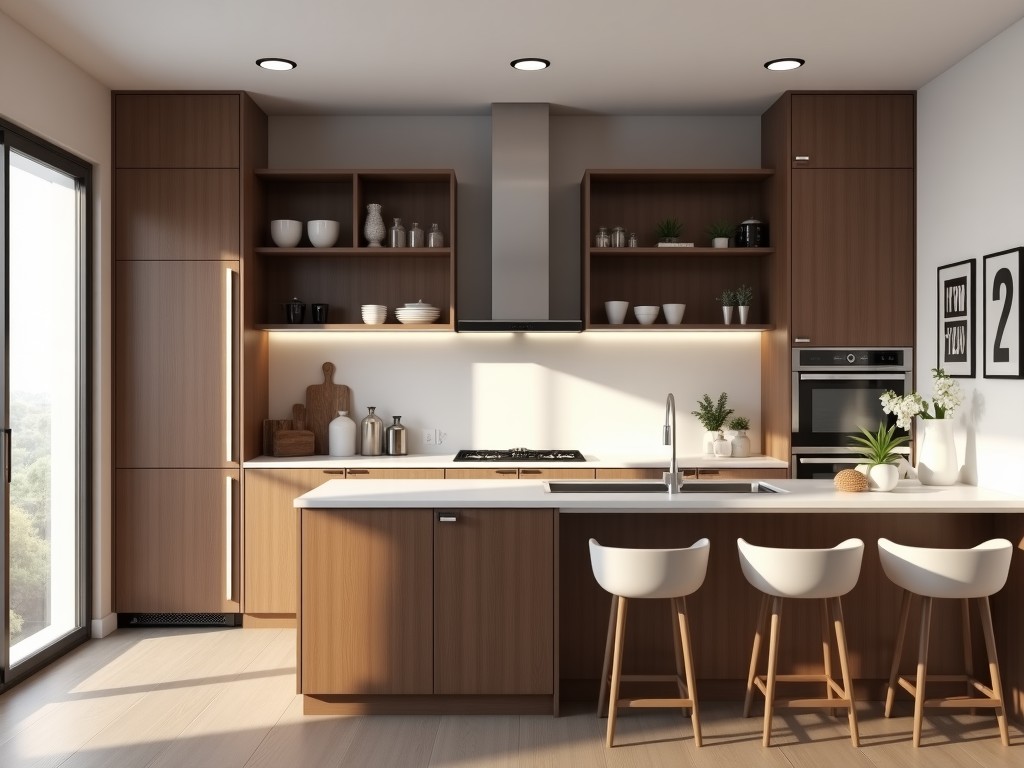
Procurement engineers evaluate cabinetry projects by breaking down material, labor, and design variables into quantifiable cost drivers. Material selection accounts for roughly 45‑55% of the total
Inquire NowProcurement engineers evaluate cabinetry projects by breaking down material, labor, and design variables into quantifiable cost drivers.
Material selection accounts for roughly 45‑55% of the total price, influenced by species, grade, and core construction.
Labor rates vary with shop complexity; CNC‑cut parts reduce machining time by 20‑30% compared to manual routing.
Finish systems (paint, stain, laminate) add 10‑20% depending on coating thickness and cure requirements.
Full‑overlay frameless construction eliminates face frames, increasing material usage by 8‑12% but reducing hardware labor.
Dovetail drawer joints provide tensile strength >4 MPa, whereas dowel‑reinforced joints average 2.5 MPa, affecting long‑term durability.
Edge banding with PUR adhesive delivers peel strength >1.8 N/mm, outperforming hot‑melt EVA which averages 1.2 N/mm.
| Material | Base Finish | Premium Finish | Typical Range |
|---|---|---|---|
| Solid Maple | Clear Coat | Hand‑Rubbed Stain | $120‑$160 |
| Engineered Veneer Core | Melamine | High‑Gloss Acrylic | $85‑$115 |
| HPL Overlay | Matte Laminate | Textured Laminate | $70‑$95 |
| Thermoformed PET | Satin Film | Metallic Foil | $95‑$130 |
In food‑processing facilities, cabinets must withstand frequent wash‑downs; therefore, stainless‑steel‑grade hardware and moisture‑resistant cores are specified.
Laboratory environments demand chemical‑resistant finishes; epoxy‑based coatings provide >95% resistance to common solvents after 24 h immersion.
Retail display kitchens prioritize aesthetic consistency; tight tolerances of ±0.5 mm on panel alignment ensure seamless visual lines across multiple units.
Incoming material is checked for moisture content using capacitance meters; acceptable range 6‑8% for solid wood, 4‑6% for engineered cores.
Dimensional verification occurs after CNC cutting; laser measurement ensures deviation <0.2 mm on critical mating surfaces.
Finish adhesion is tested per ASTM D3359; a minimum rating of 4B is required before packaging.
Submit your project specifications through our technical inquiry form to receive a itemized cost breakdown, lead time estimate, and optional value‑engineering alternatives.
Request QuoteQueenswood delivers modern bathroom solutions through original design, advanced manufacturing, and reliable quality for customers worldwide.


Middle of Xingang East Road, Haizhu District, Guangzhou City, Guangdong Province

