
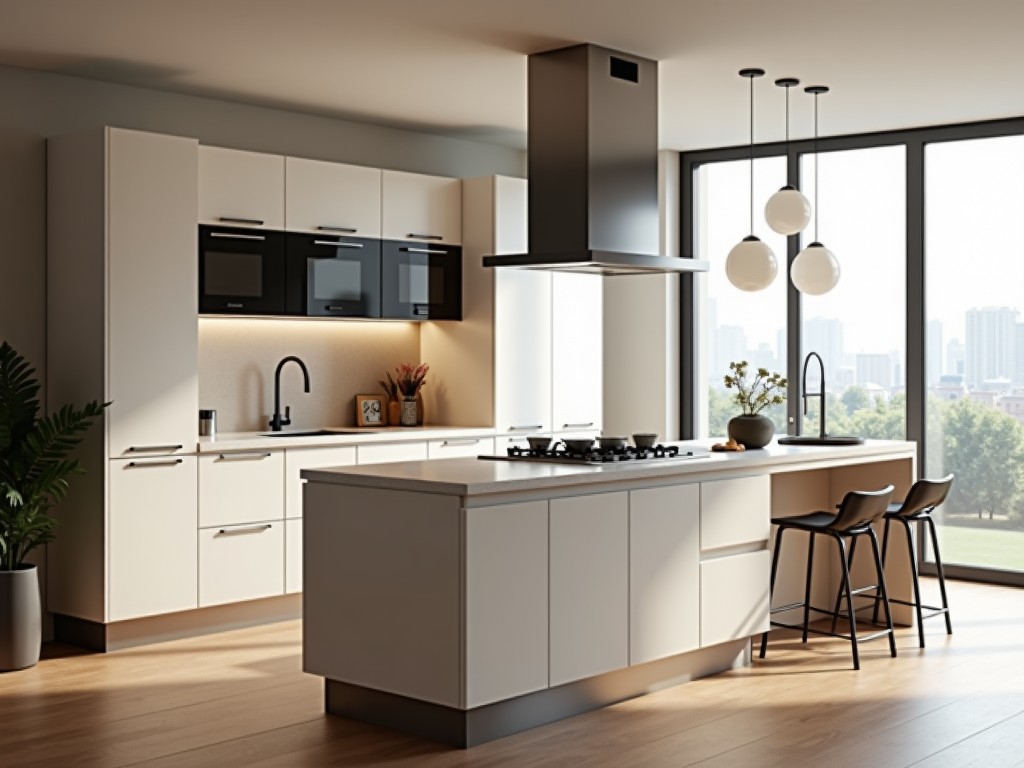
Semi‑custom cabinets are manufactured in standard modules that can be trimmed, drilled, or re‑configured on site to fit exact openings. This method provides a balance between the repeatability of
Inquire NowSemi‑custom cabinets are manufactured in standard modules that can be trimmed, drilled, or re‑configured on site to fit exact openings. This method provides a balance between the repeatability of mass production and the flexibility required for varied architectural layouts.
Typical carcass thickness ranges from 16 mm to 19 mm, providing sufficient rigidity for shelf loads up to 180 kg when supported by appropriate brackets. Standard cabinet heights are 720 mm, 800 mm, and 900 mm, with width increments of 50 mm to accommodate common wall stud spacing.
Substrates are chosen based on mechanical strength, moisture stability, and finish compatibility. Common options include 18 mm plywood (density ≈ 600 kg/m³), 16 mm MDF (density ≈ 720 kg/m³), and 15 mm particleboard with melamine overlay (density ≈ 650 kg/m³). Each material exhibits a specific modulus of elasticity that influences deflection under load.
Adjustable elements include cabinet width (in 50 mm steps), depth (standard 560 mm or optional 610 mm), door overlay (full, half, or inset), hinge type (European concealed, butt, or soft‑close), and drawer slide rating (30 kg, 45 kg, or 60 kg dynamic load). Interior accessories such as pull‑out trays, wine racks, and adjustable shelving are offered as modular inserts that attach via pre‑drilled anchorage points.
CNC panel cutting maintains a positional tolerance of ±0.3 mm, ensuring consistent dado and rabbet joints. Edge banding is applied with a hot‑melt adhesive achieving a peel strength of ≥ 1.8 N/mm. Finished surfaces undergo a cross‑hatch adhesion test (ASTM D3359) targeting a rating of 5B, indicating no removal of coating under tape stress.
In multi‑family residential projects, semi‑custom cabinets reduce on‑site carpentry hours by allowing factory‑finished units to be installed directly against pre‑framed walls, minimizing trade coordination. For hospitality environments, the ability to match specific finish colors to brand palettes while maintaining consistent module dimensions supports rapid rollout across multiple sites.
| Material | Density (kg/m³) | Modulus of Elasticity (MPa) | Typical Cost Factor* |
|---|---|---|---|
| 18 mm Plywood | 600 | 4500 | 1.0 |
| 16 mm MDF | 720 | 3000 | 0.85 |
| 15 mm Particleboard + Melamine | 650 | 2500 | 0.70 |
*Cost factor relative to plywood base; actual pricing depends on finish and order volume.
Units are shipped flat‑packed in corrugated cartons with corner protectors and edge‑board reinforcement. Each pallet is stabilized with PET strapping and covered with a polyethylene moisture barrier to limit humidity fluctuations during transit. Standard 20‑foot container loading accommodates up to 450 kg of packaged cabinets per pallet, facilitating efficient customs clearance.
Yes. Side panels and rails are supplied with extra material allowance (typically 10 mm) to permit trimming on site using a circular saw or router, enabling precise fit to uneven walls.
Melamine, PVC laminate, and UV‑cured acrylic coatings provide water vapor resistance ratings (ASTM D4541) exceeding 2.5 MPa, suitable for kitchen environments with regular steam exposure.
Shelf deflection is tested under a uniformly distributed load of 150 kg for 24 hours; acceptable deflection is limited to 2 mm per meter of span, ensuring functional integrity over typical service life.
For project‑specific quotations, please provide rough opening dimensions, desired material, finish, and hardware preferences. Our engineering team will return a detailed proposal including CNC cutting files, assembly instructions, and lead‑time estimates.
Request Technical QuoteQueenswood delivers modern bathroom solutions through original design, advanced manufacturing, and reliable quality for customers worldwide.


Middle of Xingang East Road, Haizhu District, Guangzhou City, Guangdong Province

