
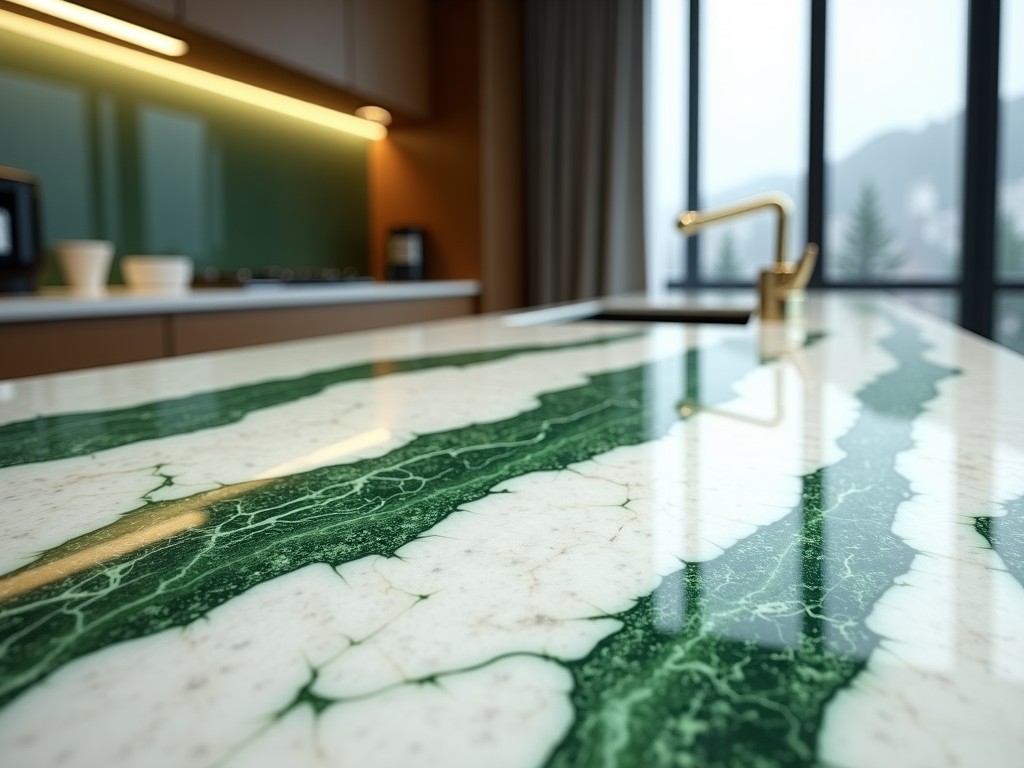
The product consists of approximately 92 % natural quartz aggregate bound with a polymer resin matrix and mineral pigments that generate the characteristic green veining. Quartz provides the primary
Inquire NowThe product consists of approximately 92 % natural quartz aggregate bound with a polymer resin matrix and mineral pigments that generate the characteristic green veining. Quartz provides the primary load‑bearing framework, while the resin imparts cohesion and enables surface finishing. Typical slab dimensions reach 3200 mm × 1600 mm with thicknesses ranging from 12 mm to 30 mm, allowing flexibility for various installation requirements.
Quartz content exceeding 90 % yields a Mohs hardness of 7, suitable for high‑wear surfaces. The resin binder contributes a flexural strength of approximately 45 MPa and a compressive strength near 180 MPa, measured per ASTM C170. Water absorption remains below 0.05 % due to the non‑porous nature of the cured matrix.
Green veins originate from dispersed chromite and serpentine particulates that are introduced during mixing and align under vacuum vibration, producing linear features with widths typically between 0.5 mm and 3 mm. Color variance is controlled by pigment concentration, delivering CIE L*a*b* values in the range L* 45‑55, a* ‑10‑‑5, b* 20‑30 for consistent visual matching across batches.
| Attribute | Typical Range |
|---|---|
| Vein width (mm) | 0.5 – 3.0 |
| Veining density (veins/dm²) | 4 – 12 |
| Color deviation ΔE* | ≤ 2.0 (within batch) |
Raw quartz, resin, and pigments are blended under vacuum to eliminate entrapped air, then poured into molds and subjected to vibration‑assisted compaction at 0.8 MPa. Curing occurs in a controlled‑temperature oven at 80 °C for 90 minutes, achieving full polymer cross‑linking before calibration and polishing to a 0.2 µm Ra finish.
Post‑cure inspection includes thickness verification (±0.1 mm), surface gloss measurement (60° gloss > 85 GU), and edge straightness checks (±0.2 mm over 1 m).
The low water absorption and high chemical resistance make the slabs suitable for laboratory countertops where exposure to acids and solvents is common. In hospitality environments, the combination of abrasion resistance and aesthetic veining supports high‑traffic bar tops and reception desks without visible wear over five‑year cycles.
Each production lot undergoes a standardized test regime covering flexural strength (ASTM C1180), water absorption (ASTM C97), and surface hardness (ASTM D3359). Results are logged against specification limits; any deviation triggers a root‑cause analysis involving raw‑material batch review and equipment calibration verification.
Traceability is maintained through laser‑etched lot identifiers on the slab back, enabling linkage to resin supplier certificates and quartz source documentation.
Thickness can be selected from 12 mm, 20 mm, or 30 mm to match structural support requirements. Edge profiles include eased, beveled, bullnose, and ogee, each fabricated using CNC profiling with tolerance ±0.1 mm. Surface finishes range from polished to honed or brushed, offering gloss values from 15 GU (honed) to 95 GU (polished).
Slab dimensions are adjustable within the maximum press envelope; custom lengths up to 3400 mm and widths up to 1700 mm are available upon request, with corresponding adjustments to transportation packaging.
| Property | Value | Test Method |
|---|---|---|
| Mohs hardness | 7 | EN 101 |
| Flexural strength | 45 MPa | ASTM C1180 |
| Compressive strength | 180 MPa | ASTM C170 |
| Water absorption | 0.04 % | ASTM C97 |
| Density | 2.35 g/cm³ | ISO 1183‑1 |
Queenswood delivers modern bathroom solutions through original design, advanced manufacturing, and reliable quality for customers worldwide.


Middle of Xingang East Road, Haizhu District, Guangzhou City, Guangdong Province

