
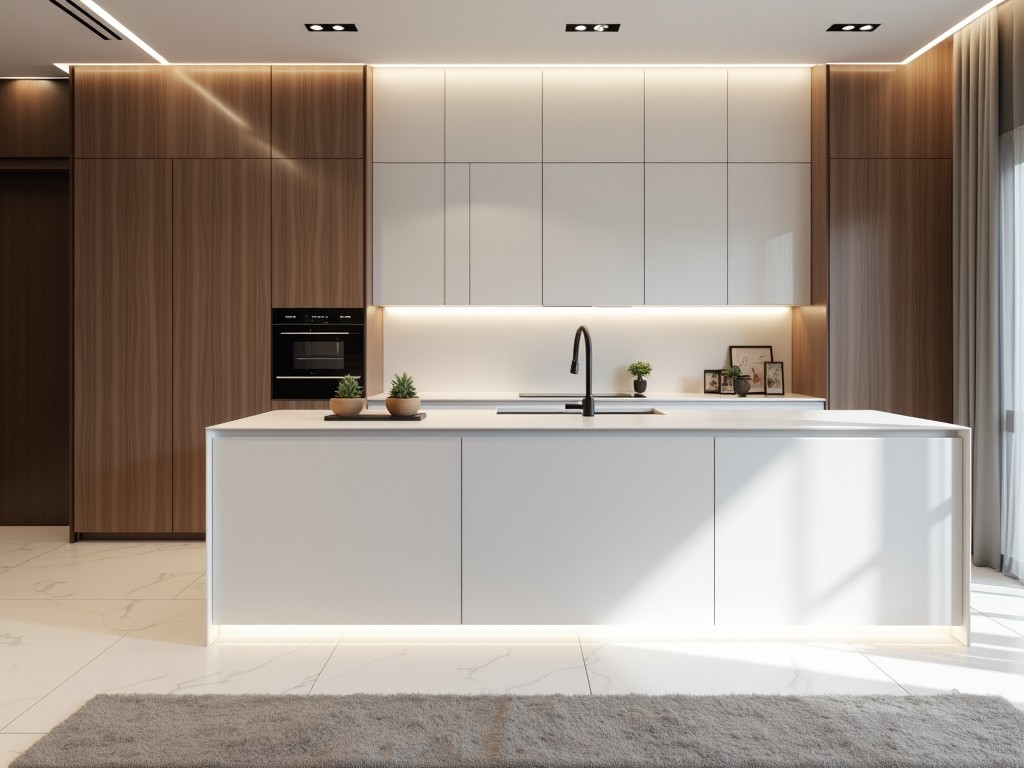
Quartz countertops consist of approximately 90‑95% ground natural quartz aggregate combined with polymer resins and pigments. The quartz particles provide hardness typically measured at 7 on the Mohs
Inquire NowQuartz countertops consist of approximately 90‑95% ground natural quartz aggregate combined with polymer resins and pigments. The quartz particles provide hardness typically measured at 7 on the Mohs scale, while the resin binder contributes flexural strength around 30‑40 MPa. This combination yields a non‑porous surface with water absorption below 0.02% by weight.
Pigment loading is controlled to achieve color consistency within ΔE<2 across a slab, ensuring minimal visual variation. The manufacturing process involves vacuum vibration compaction at pressures exceeding 100 bar, which reduces internal voids and improves density to about 2.3 g/cm³.
Slab thickness directly affects material usage and processing time. Common thicknesses are 12 mm, 20 mm, and 30 mm; each increment increases raw quartz consumption linearly and adds approximately 15‑20% to handling and polishing cycle time.
Edge profiling options such as eased, beveled, ogee, or waterfall require additional CNC machining steps. A typical eased edge adds about 2‑3 minutes per linear meter, whereas a complex ogee profile can add 8‑10 minutes, impacting labor cost per square foot.
Surface finishes range from polished (gloss units 70‑90), honed (gloss 20‑40), to textured (e.g., leather, sandblasted). Polished finishes demand finer abrasive passes, increasing energy consumption by roughly 10% compared to honed finishes.
Logistics factors such as inland transportation from the manufacturing hub to the port, container loading efficiency, and destination tariffs also modify the final quoted price per square foot.
| Thickness | Finish | Quartz Purity | Price Range (USD/ft²) |
|---|---|---|---|
| 12 mm | Honed | Standard (90‑92%) | 45 – 55 |
| 20 mm | Polished | High (93‑95%) | 65 – 80 |
| 30 mm | Textured (Leather) | Premium (≥96%) | 85 – 110 |
| 20 mm | Polished | Standard with metallic pigment | 70 – 90 |
Values are indicative and vary according to project‑specific factors such as order volume, edge treatment, and delivery terms.
These additive costs are calculated based on standard machining rates and material consumption; final quotations reflect the exact geometry supplied in CAD files.
Each slab undergoes thickness tolerance verification (±0.1 mm) using laser micrometers, surface flatness assessment (≤0.5 mm deviation over 1 m), and resin cure monitoring via DSC to ensure glass transition temperature within spec.
Color consistency is checked under D65 lighting with a spectrophotometer; batches exceeding ΔE>2 are re‑processed. Mechanical testing includes flexural strength (ASTM C1240) and impact resistance (ISO 179) on representative samples from each production lot.
Documentation such as material safety data sheets (MSDS) and test reports are available upon request, supporting traceability for project specifications.
Quartz countertops are selected for laboratory workstations where chemical resistance to acids and solvents is required; the non‑porous surface prevents microbial growth and simplifies cleaning protocols.
In food‑processing facilities, the material complies with FDA‑grade standards for direct food contact when formulated with NSF‑approved resins, providing a durable surface that withstands frequent wash‑down cycles.
Office reception desks and retail display benches benefit from the aesthetic consistency and low maintenance, reducing lifecycle cost compared to natural stone that may require periodic sealing.
To obtain a precise price per square foot for your project, share the specifications outlined above. Our technical team will review the details and provide a detailed quotation including material, processing, and logistics costs.
Contact Us for a QuoteQueenswood delivers modern bathroom solutions through original design, advanced manufacturing, and reliable quality for customers worldwide.


Middle of Xingang East Road, Haizhu District, Guangzhou City, Guangdong Province

