
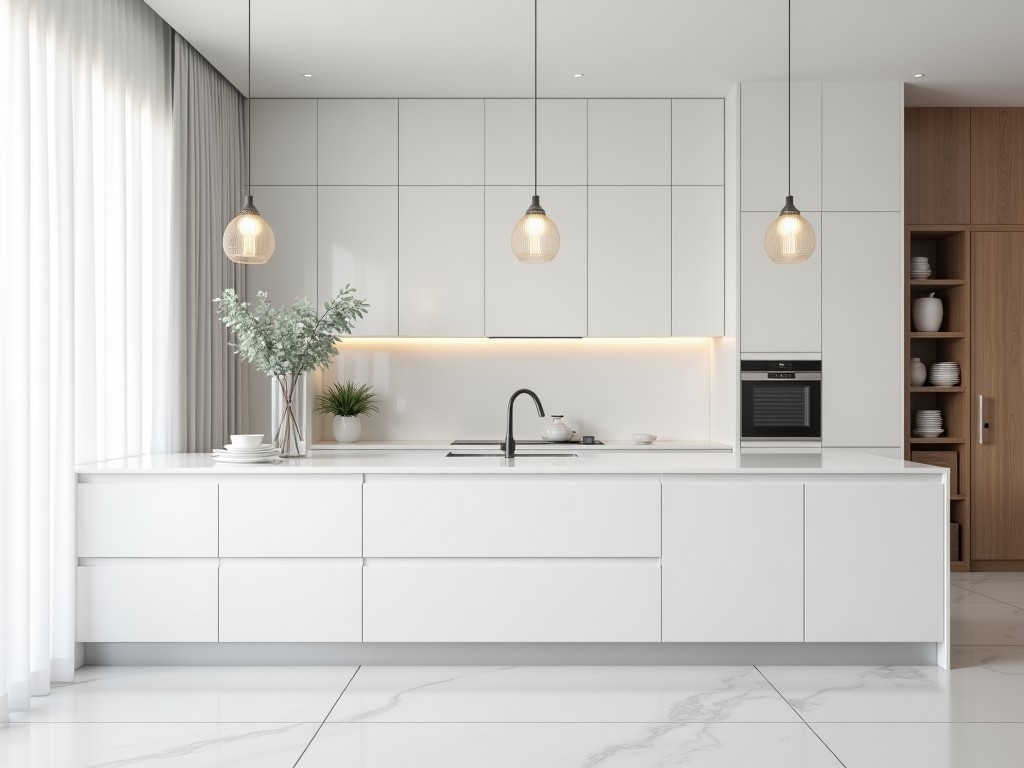
Plain white quartz countertops are engineered slabs composed of approximately 90–95% ground natural quartz combined with polymer resins and pigments. The high quartz content provides the slab with
Inquire NowPlain white quartz countertops are engineered slabs composed of approximately 90–95% ground natural quartz combined with polymer resins and pigments. The high quartz content provides the slab with inherent scratch resistance and a non‑porous surface, while the resin binds the particles and enables consistent coloration. This combination results in a material suitable for demanding industrial environments where hygiene and durability are critical.
The quartz fraction provides the slab with inherent scratch resistance and a non‑porous surface that resists staining from most chemicals.
Polymer resin binds the quartz particles, imparting flexibility and enabling consistent coloration throughout the slab without the need for additional pigments.
Typical values for key performance indicators are shown below.
| Property | Typical Value |
|---|---|
| Slab thickness | 20 mm (3/4 in) or 30 mm (1 1/4 in) |
| Density | 2.3–2.5 g/cm³ |
| Water absorption | <0.05 % |
| Flexural strength | ≈40 MPa |
| Mohs hardness | ≈7 |
| Thermal expansion coefficient | ≈25 × 10⁻⁶/°C |
Because the surface is non‑porous and resistant to most acids, alkalis, and solvents, plain white quartz countertops are frequently selected for environments that require strict cleanliness and easy sanitation.
Dimensional tolerance is verified on each slab, with thickness variation typically held within ±0.1 mm and length/width within ±2 mm.
Surface flatness is measured using a straight‑edge and feeler gauge, ensuring deviations do not exceed 0.5 mm over a 1 m span.
Color consistency is assessed under standardized lighting (D65) using a spectrophotometer, with ΔE values kept below 2.0 to guarantee uniform appearance.
Mechanical properties such as flexural strength and water absorption are tested according to ASTM C127 and C97 protocols, and results are recorded for each production batch.
Slabs can be fabricated to meet specific project dimensions, edge profiles, and cut‑out requirements without compromising material integrity.
Finished slabs are stacked face‑to‑face with protective interleaving film to prevent surface abrasion during transit.
Each pack is secured inside a wooden crate reinforced with corner protectors and steel straps, then wrapped in stretch film to guard against moisture.
Standard pallet dimensions accommodate forklift handling, and shipping marks include batch numbers, thickness, and destination details for traceability.
Can dimensions be customized? Yes, slabs are cut to project‑specific lengths and widths; maximum slab size is typically 3200 mm × 1600 mm.
What information is required before quotation? Please provide desired thickness, overall dimensions, edge profile, and any cut‑out details.
How is quality inspected? Refer to the Quality Control section for dimensional, surface, and color tolerances.
For technical data sheets or to discuss project‑specific requirements, please contact our sales team.
Queenswood delivers modern bathroom solutions through original design, advanced manufacturing, and reliable quality for customers worldwide.


Middle of Xingang East Road, Haizhu District, Guangzhou City, Guangdong Province

