
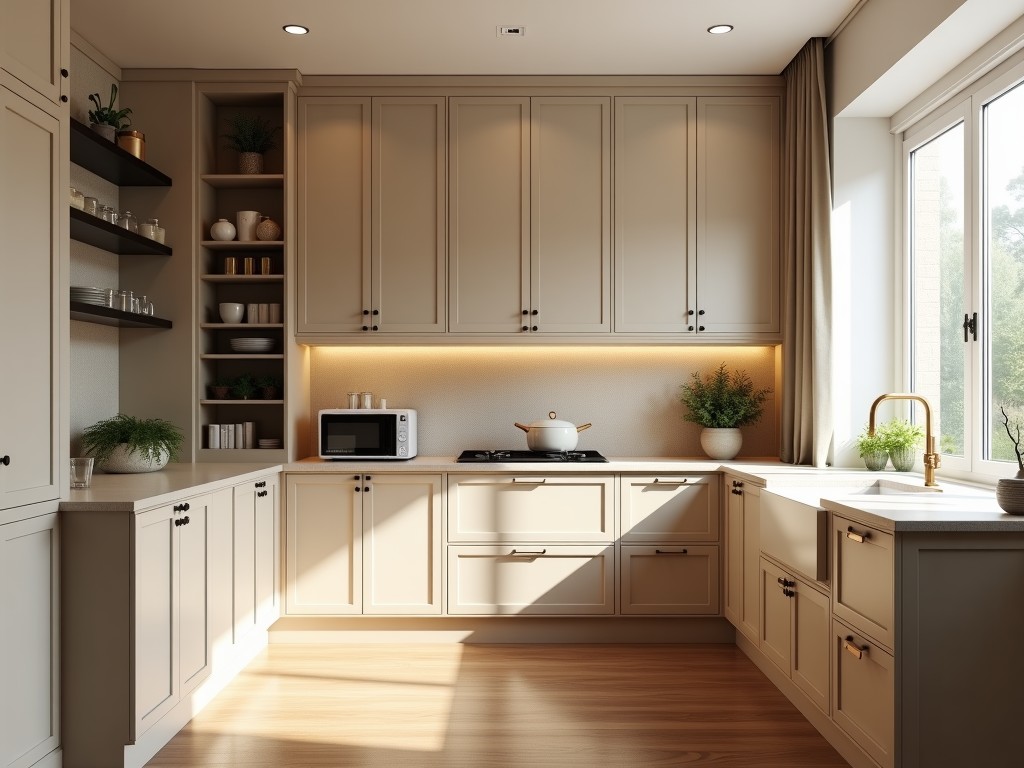
Custom painted kitchen cabinets combine a manufactured wood substrate with a multi‑layer coating system that provides a seamless finish, tight colour control and surface durability suitable for
Inquire NowCustom painted kitchen cabinets combine a manufactured wood substrate with a multi‑layer coating system that provides a seamless finish, tight colour control and surface durability suitable for high‑use environments.
Common substrates include medium‑density fibreboard (MDF) with an E1 formaldehyde rating (<0.1 ppm), particleboard, plywood and solid wood strips. Panel thicknesses typically range from 16 mm to 22 mm, with density values between 600 kg/m³ for particleboard and 750 kg/m³ for high‑grade MDF. Edge sealing is applied to limit moisture ingress and maintain dimensional stability.
The coating system consists of a UV‑curable or thermally cured primer, a pigmented basecoat and a clear topcoat. Dry film thickness is controlled to 40‑60 µm per coat, giving a total thickness of approximately 120‑180 µm. Typical performance values include adhesion rating of 5B (ASTM D3359), pencil hardness of HB‑2H, VOC content below 50 g/L and colour difference ΔE < 2 after curing.
Design flexibility is achieved through selectable door styles, dimensions, edge treatments and finish specifications.
Production begins with CNC cutting of substrate panels to nominal size, followed by edge banding and sanding to achieve a surface roughness Ra < 0.8 µm. A primer is applied via curtain coater or spray, then cured using UV lamps (energy 120‑150 mJ/cm²) or a convection oven (80‑100 °C). After sanding the primer to remove surface defects, a basecoat is sprayed, cured and lightly sanded. Finally a clear topcoat is applied, cured and allowed to cool before inspection.
Each batch undergoes adhesion testing (cross‑hatch method) with a minimum pass of 5B, pencil hardness measurement, dry film thickness verification with a micrometer, and colour assessment using a spectrophotometer (ΔE < 2). Additional checks include resistance to humid conditions (240 h at 40 °C/95 % RH) and impact resistance (ASTM D2794) to ensure durability in kitchen environments.
In multi‑family residential projects, painted cabinets provide a uniform appearance across units while allowing individual colour selection for tenant customization. Hospitality installations benefit from the coating’s resistance to frequent cleaning agents and steam exposure. Senior‑living facilities specify low‑VOC finishes and smooth edges to meet accessibility and indoor‑air‑quality standards.
| Parameter | Typical Value / Option |
|---|---|
| Substrate | MDF (E1), Particleboard, Plywood, Solid Wood |
| Panel Thickness | 16 mm, 18 mm, 22 mm (custom) |
| Density | 600‑750 kg/m³ (depending on material) |
| Primer Type | UV‑curable acrylic or polyester |
| Basecoat Type | Pigmented polyurethane or acrylic |
| Topcoat Type | Clear polyurethane, UV‑curable or thermally cured |
| Dry Film Thickness (total) | 120‑180 µm |
| Adhesion (ASTM D3359) | 5B (no removal) |
| Pencil Hardness | HB‑2H |
| VOC Content | <50 g/L |
| Colour Difference (ΔE) | <2 (after cure) |
| Humidity Resistance | No blistering after 240 h at 40 °C/95 % RH |
| Fire Rating (optional) | Class B‑s2, d0 (upon request) |
Queenswood delivers modern bathroom solutions through original design, advanced manufacturing, and reliable quality for customers worldwide.


Middle of Xingang East Road, Haizhu District, Guangzhou City, Guangdong Province

