
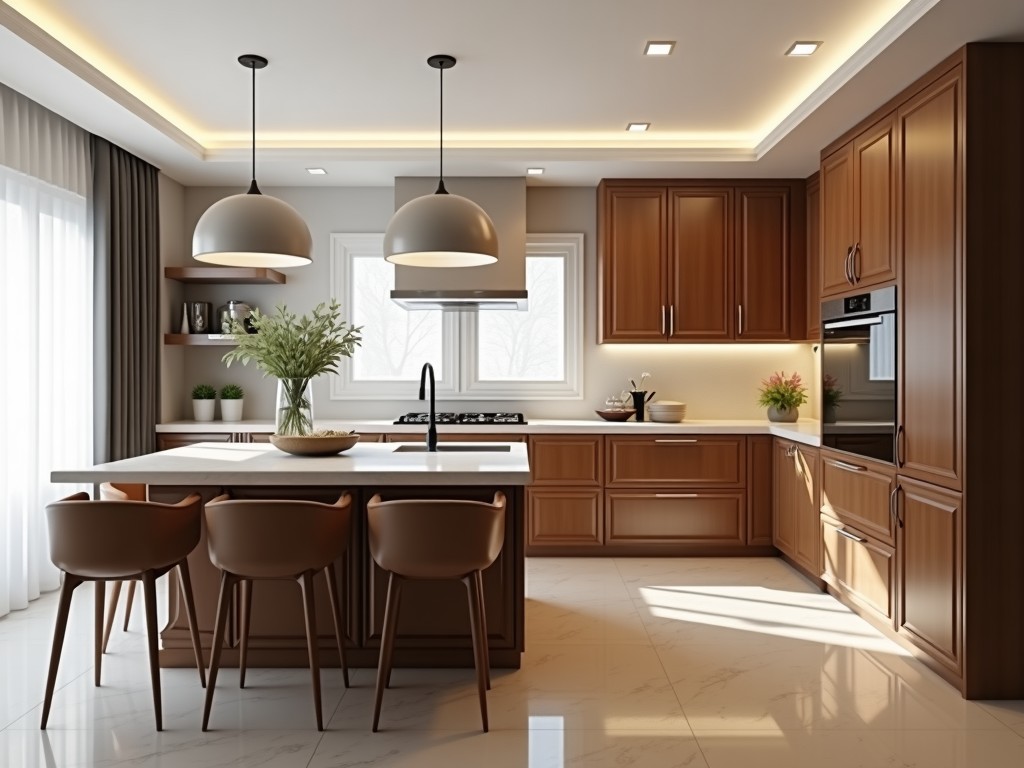
Custom kitchen cabinet manufacturers in China produce cabinetry based on client‑provided CAD models, using panel processing equipment that achieves dimensional tolerances of ±0.3 mm on cut edges and
Inquire NowCustom kitchen cabinet manufacturers in China produce cabinetry based on client‑provided CAD models, using panel processing equipment that achieves dimensional tolerances of ±0.3 mm on cut edges and ±0.2 mm on hole locations.
The choice of core material influences weight, moisture resistance, and formaldehyde emissions. Typical substrates include:
Cabinet panels are joined using a combination of mechanical fasteners and adhesive systems to ensure load‑bearing capacity and dimensional stability.
The process translates design data into production instructions while minimizing material waste.
Inspection is performed at multiple stages to verify conformance to technical specifications.
| Parameter | Typical Value | Customizable Range |
|---|---|---|
| Panel thickness | 18 mm | 12‑30 mm |
| Density (MDF) | 720 kg/m³ | 650‑800 kg/m³ |
| Formaldehyde emission | ≤ 0.07 mg/m³ (CARB Phase 2) | ≤ 0.04 mg/m³ (Super E0) available |
| Edge banding thickness | 0.4 mm PVC | 0.3‑0.6 mm PVC, ABS, or wood veneer |
| Cam‑lock tensile strength | 1.2 kN per joint | 0.8‑1.5 kN (optional steel inserts) |
Q: Can dimensions be customized to match existing kitchen layouts?
A: Yes. CNC programming allows any length, width, and height within the machine travel limits (up to 3000 mm × 1500 mm × 750 mm) with ±0.2 mm positional accuracy.
Q: What information is required before a quotation can be issued?
A: Complete CAD files (STEP/IGES/DXF), material selection, finish type (melamine, lacquer, veneer), hardware specifications, and required tolerances.
Q: Which materials are available for cabinet boxes and doors?
A: Particleboard, MDF, plywood, and solid wood strips for boxes; doors can be made from the same substrates with optional HPL, acrylic, or glass inserts.
Q: How is quality inspected before shipment?
A: Each unit undergoes dimensional check, edge‑band adhesion test, joint torque verification, and surface finish measurement; a QC report is attached to the packing list.
Q: What packaging methods protect cabinets during export?
A: Flat‑packed panels are placed in corrugated cardboard sleeves with corner protectors, then stacked on pallets and stretch‑wrapped; optional wooden crates for high‑value items.
Q: What is the typical production lead time?
A: Lead time ranges from 18 to 28 working days after design approval, depending on order size and material availability.
To discuss material selection, tolerance requirements, or to obtain a detailed quote, please contact our engineering team.
Contact UsQueenswood delivers modern bathroom solutions through original design, advanced manufacturing, and reliable quality for customers worldwide.


Middle of Xingang East Road, Haizhu District, Guangzhou City, Guangdong Province

