
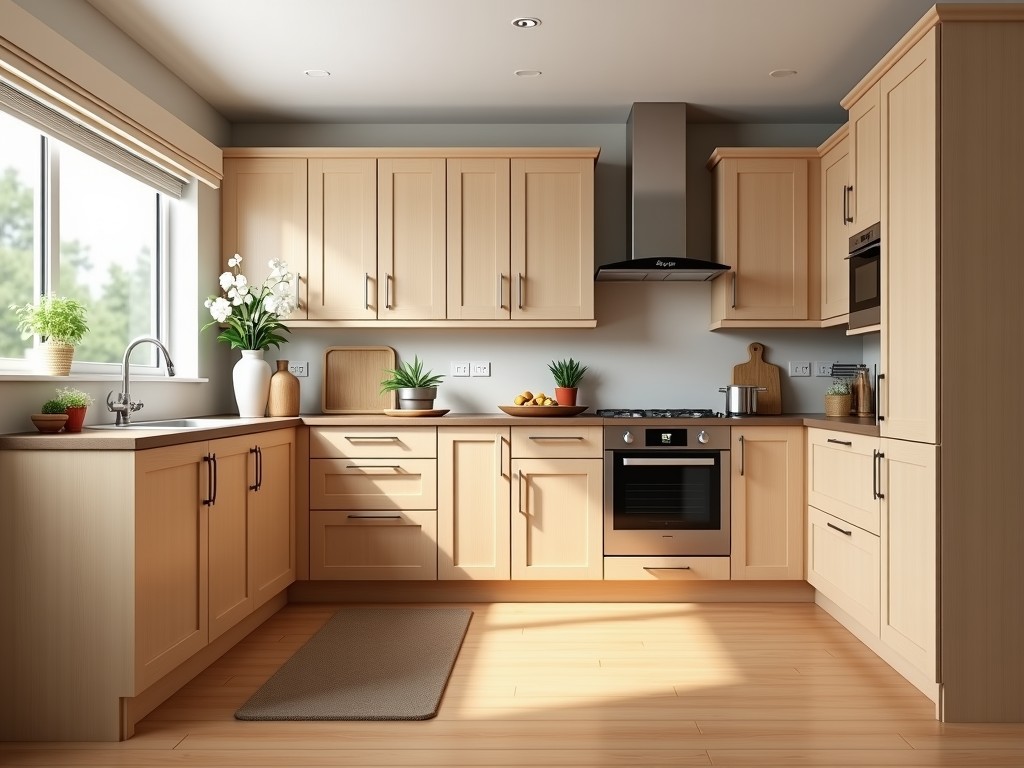
Industrial kitchen projects require cabinetry that balances dimensional stability, load-bearing capacity, and resistance to moisture. Plywood constructed from cross‑bonded veneer sheets provides
Inquire NowIndustrial kitchen projects require cabinetry that balances dimensional stability, load-bearing capacity, and resistance to moisture.
Plywood constructed from cross‑bonded veneer sheets provides predictable performance under cyclic humidity changes typical in commercial food‑service environments.
Typical cabinet panels use 3‑ to 5‑ply hardwood plywood with a face veneer of birch or maple.
Each ply is bonded with a phenol‑formaldehyde resin that meets E0 emission standards, ensuring low volatile organic compound release.
Core veneers are often poplar or pine, selected for uniform thickness and minimal internal voids.
Panel edges are machined to receive 6 mm deep dado joints for shelf support, providing a shear load capacity of approximately 1.2 kN per joint.
Cam‑lock fasteners are used for corner assembly, allowing disassembly and reassembly without loss of alignment.
All exposed surfaces receive a 0.2 mm UV‑cured coating that increases surface hardness to ≥2 H on the pencil hardness scale.
Dimensional tolerance is maintained within ±0.5 mm for length and width.
Moisture content is measured via oven‑dry method and kept between 6 % and 8 % before finishing.
Adhesion of the face veneer is evaluated using a peel test according to ISO 6238, with a minimum acceptable value of 1.5 N/mm.
Surface finish is inspected under 500 lux illumination for defects such as blushing, orange peel, or uneven gloss.
Any panel exceeding a defect density of 0.2 defects/dm² is diverted for rework.
| Parameter | Typical Value | Customizable Options | Notes |
|---|---|---|---|
| Thickness | 18 mm (3‑ply) to 25 mm (5‑ply) | 16 mm, 20 mm, 22 mm, 28 mm upon request | Nominal thickness affects load capacity |
| Density | 600‑700 kg/m³ | Higher density core available | Influences screw withdrawal strength |
| Formaldehyde Emission | E0 (<0.5 mg/L) | CARB2, NAF | Compliant with most indoor air quality standards |
| Moisture Content | 6‑8 % (oven‑dry) | Pre‑conditioned to specific RH | Controlled to minimize post‑install movement |
| Surface Hardness | ≥2 H (pencil) | UV‑coated, melamine, veneer | Affects scratch resistance |
| Edge Bond Strength | ≥1.5 N/mm (peel) | Higher strength adhesives | Ensures durability of edge banding |
Yes, cabinet height, width, and depth can be adjusted to match specific layout requirements; custom sizes are quoted after reviewing detailed drawings.
Project drawings or sketches, desired panel thickness, face veneer selection, edge banding type, hardware preferences, and any special finish or certification needs.
Each batch undergoes dimensional checks, moisture content testing, adhesion peel tests, and visual surface inspection under standardized lighting before packaging.
Contact our engineering team to review specifications, obtain a formal quote, and arrange sample panels for evaluation.
Request QuoteQueenswood delivers modern bathroom solutions through original design, advanced manufacturing, and reliable quality for customers worldwide.


Middle of Xingang East Road, Haizhu District, Guangzhou City, Guangdong Province

