
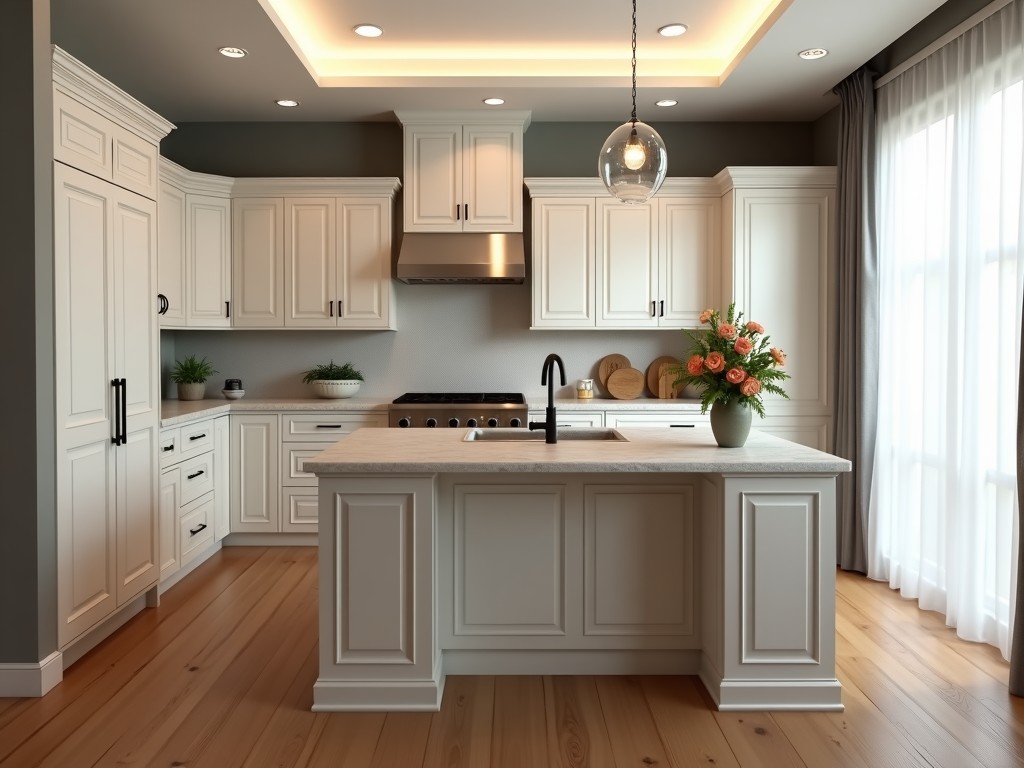
Custom kitchen cabinets are built to fit specific room dimensions, storage needs, and design preferences. This page outlines the technical factors that influence performance, durability, and
Inquire NowCustom kitchen cabinets are built to fit specific room dimensions, storage needs, and design preferences. This page outlines the technical factors that influence performance, durability, and installability.
Cabinet boxes typically use 18 mm thick medium-density fiberboard (MDF) or particleboard with a density of 650–750 kg/m³. The core provides bending stiffness; a 18 mm panel resists sag under a 20 kg load over a 600 mm span with less than 0.5 mm deflection.
Edge protection is applied with 0.6 mm PVC or ABS banding, bonded using hot-melt adhesive with a peel strength ≥ 1.5 N/mm. This prevents moisture ingress and impact chipping.
| Parameter | Typical Value | Customizable Range |
|---|---|---|
| Cabinet height (base) | 720 mm | 600–900 mm |
| Cabinet depth | 560 mm | 450–650 mm |
| Door thickness | 18 mm | 16–22 mm |
| Shelf thickness | 18 mm | 16–25 mm |
| Back panel thickness | 3 mm | 2.5–4 mm |
Each cabinet undergoes dimensional verification using laser measurement (±0.1 mm tolerance). Edge band adhesion is tested per ASTM D903, requiring minimum peel strength of 1.5 N/mm. Load testing of shelves applies a uniformly distributed load of 40 kg for 24 hours; deflection must remain under 0.3 mm.
Finish durability is evaluated with Taber abrasion tester (CS‑10 wheels, 500 g load). A typical melamine finish shows ≤ 15 mg weight loss after 1000 cycles, corresponding to a wear rating suitable for residential kitchen use.
In residential installations, cabinets align precisely with appliances, reducing gaps that can harbor debris. In commercial settings, the increased load capacity of shelves (up to 50 kg) supports bulk storage of ingredients, while the moisture‑resistant edge banding prevents swelling in high‑humidity environments.
To discuss your project requirements, request a quote, or obtain sample panels, please reach out to our engineering team.
Request QuoteQueenswood delivers modern bathroom solutions through original design, advanced manufacturing, and reliable quality for customers worldwide.


Middle of Xingang East Road, Haizhu District, Guangzhou City, Guangdong Province

