
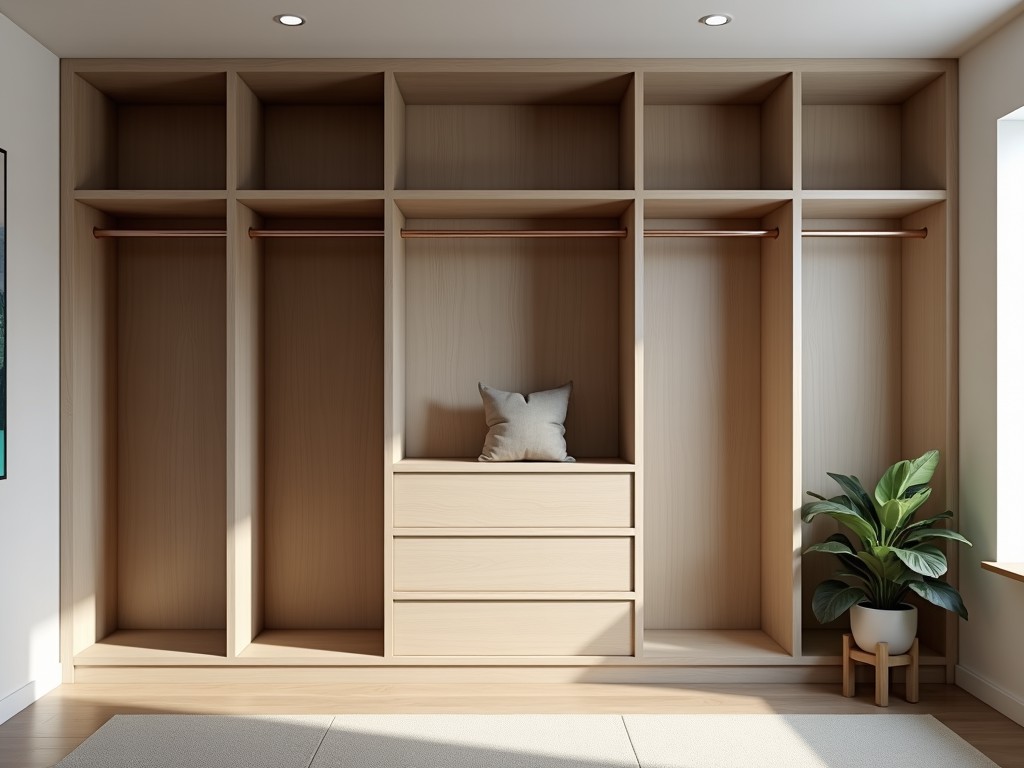
Bulk custom built closet shelving refers to modular shelving systems produced in volume to meet specific project dimensions and load requirements. Unlike standard off‑the‑shelf units, each component
Inquire NowBulk custom built closet shelving refers to modular shelving systems produced in volume to meet specific project dimensions and load requirements. Unlike standard off‑the‑shelf units, each component is fabricated to exact length, width, and thickness based on engineering calculations for deflection and safety factor.
The design process starts with determining the maximum uniformly distributed load (UDL) per shelf, typically expressed in kg/m², and selecting a material thickness that limits deflection to less than L/180 under that load, where L is the span between supports. Edge stiffeners or return flanges are often added to increase bending resistance without significantly increasing weight.
Common substrates include cold‑rolled steel (CRS), hot‑dip galvanized steel, extruded aluminum alloys, and engineered wood panels such as MDF or particleboard with protective overlays. Each material offers distinct mechanical properties, corrosion resistance, and weight characteristics that influence shelf spacing and support design.
| Material | Typical Thickness (mm) | Yield Strength (MPa) | Density (g/cm³) | Corrosion Protection |
|---|---|---|---|---|
| Cold‑rolled steel | 0.8 – 2.0 | 250 – 350 | 7.85 | Paint, powder coat, or galvanize |
| Hot‑dip galvanized steel | 0.8 – 2.0 | 250 – 350 | 7.85 | Zn coating (≈55 µm) |
| Aluminum 6063‑T5 | 1.0 – 2.5 | 140 – 210 | 2.70 | Anodize or powder coat |
| Particleboard (melamine) | 12 – 22 | — (composite) | 0.60 – 0.75 | Melamine overlay (moisture resistant) |
Shelves can be produced in lengths from 300 mm to 2400 mm in 50 mm increments, widths from 200 mm to 600 mm, and thicknesses according to the material table above. Shelf spacing (clear vertical distance between adjacent shelves) is adjustable in 25 mm steps to accommodate varying item heights. Bracket types include pin‑and‑hole, cleat, or concealed metal supports, each rated for specific shear and moment capacities.
Production begins with CNC punching or laser cutting of blanks to the specified length and width, followed by forming operations such as bending, flanging, or hemming to create shelf profiles and stiffeners. Welding or mechanical fasteners are used to attach brackets and reinforcements. After forming, surfaces undergo cleaning, pretreatment, and coating application, then curing in convection ovens at temperatures defined by the coating specification.
Dimensional verification is performed using calibrated calipers and laser scanners, ensuring length tolerances within ±0.5 mm and squareness within 0.2 mm per meter. Load testing of random samples applies a uniform load equal to 1.5× the design UDL for a duration of 24 hours, measuring residual deflection to confirm elastic recovery. Coating thickness is checked with a magnetic or eddy‑current gauge, targeting the minimum specified value with a ±10 % tolerance.
Bulk custom built closet shelving is employed in high‑density storage environments where standardized units cannot meet the required geometry or load paths, such as retail back‑rooms, warehouse picking stations, and residential walk‑in closets. By tailoring shelf depth and spacing to the specific product mix, facilities reduce handling time and improve inventory visibility. The modular nature also allows reconfiguration as storage needs evolve, minimizing long‑term capital expenditure.
To discuss your project specifications and receive a detailed quotation, please contact our engineering team.
Queenswood delivers modern bathroom solutions through original design, advanced manufacturing, and reliable quality for customers worldwide.


Middle of Xingang East Road, Haizhu District, Guangzhou City, Guangdong Province

