
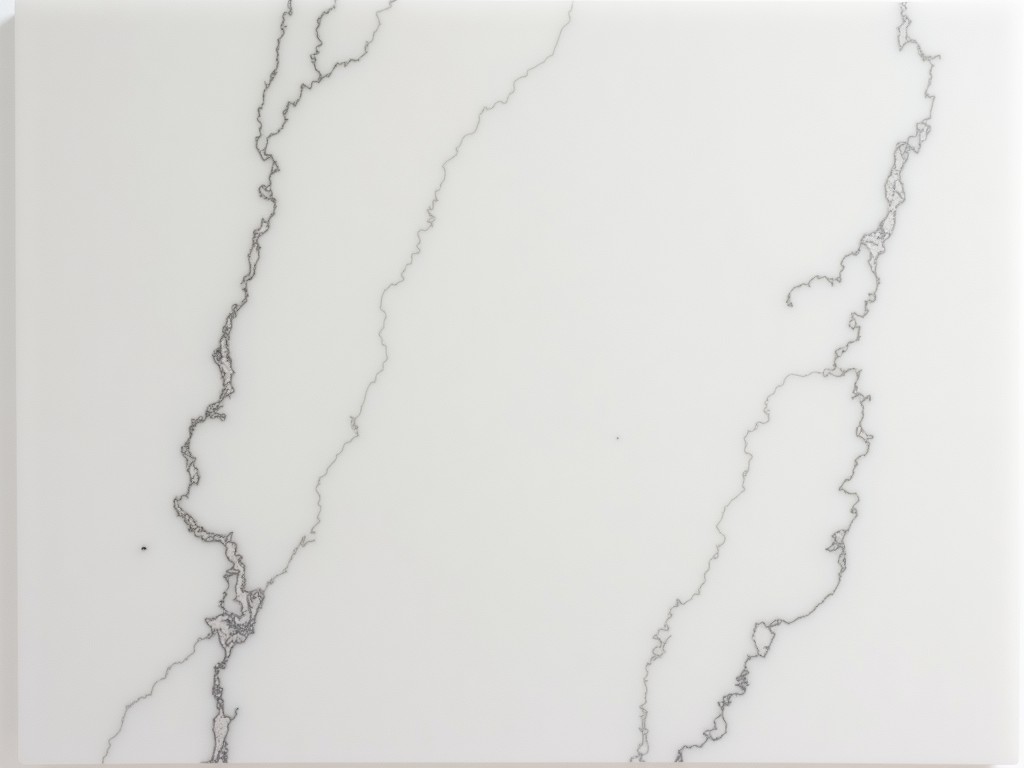
White speckled quartz countertops are engineered surfaces made from natural quartz crystals bound with polymer resins and mineral pigments. The speckled effect is created by uniformly dispersing fine
Inquire NowWhite speckled quartz countertops are engineered surfaces made from natural quartz crystals bound with polymer resins and mineral pigments. The speckled effect is created by uniformly dispersing fine reflective particles throughout the matrix, yielding a consistent appearance that masks minor variations across large slabs.
These slabs are fabricated to tight dimensional tolerances, typically ±0.5 mm on length and width, and are supplied in standard thicknesses of 20 mm, 30 mm, and 40 mm. The non‑porous surface resists liquid absorption, making it suitable for environments where hygiene and chemical exposure are concerns.
The quartz content ranges from 90 % to 95 % by weight, sourced from high‑purity deposits with silica levels above 99.5 %. The remaining 5 % to 10 % consists of a proprietary unsaturated polyester resin system, UV stabilizers, and inorganic pigments that produce the white base and speckle tones.
Speckle particles are typically ground mica or recycled glass, sized between 50 µm and 200 µm, and added at a controlled dosage of 0.2 % to 0.8 % to achieve the desired visual density without compromising mechanical integrity.
Raw quartz and resin are blended in a vacuum mixer to eliminate entrapped air, then poured into molds and vibrated under vacuum pressure to ensure uniform density. The mixture is cured in a temperature‑controlled oven at 85 °C for 45 minutes, followed by calibration through precision grinding and polishing to achieve a surface roughness of Ra 0.05 µm.
Each slab undergoes a final inspection for thickness variation, color consistency, and surface defects before being cut to customer‑specified dimensions.
| Property | Typical Value | Test Method |
|---|---|---|
| Density | 2.45 g/cm³ | ASTM C97 |
| Compressive Strength | 180 MPa | ASTM C170 |
| Flexural Strength | 55 MPa | ASTM C880 |
| Water Absorption | 0.02 % | ASTM C97 |
| Stain Resistance (Coffee, Oil, Wine) | No visible stain after 24 h exposure | ANSI/NSF 51 |
| Heat Resistance (Short‑Term) | Withstands 180 °C for 5 min without discoloration | Manufacturer internal test |
The high quartz content provides a Mohs hardness of approximately 7, offering resistance to scratching from typical kitchen utensils and laboratory equipment. The non‑porous surface prevents bacterial ingress, supporting compliance with food‑safe and medical‑facility standards.
Thermal expansion coefficient is measured at 25 × 10⁻⁶ /°C, allowing the material to endure temperature fluctuations common in industrial settings without cracking. Chemical resistance testing shows no degradation after exposure to dilute acids (pH 2) and alkalis (pH 12) for 48 hours.
In hospitality environments, the speckled finish conceals wear patterns and seam lines, maintaining a uniform appearance over high‑traffic service counters. The material’s resistance to staining from food pigments and cleaning agents reduces maintenance cycles.
Healthcare facilities benefit from the non‑porous surface, which inhibits microbial growth and allows for effective disinfection with standard hospital‑grade agents. The ability to withstand frequent temperature changes from hot equipment makes it suitable for laboratory workstations.
Industrial kitchens and food processing plants select this product for its impact resistance and ease of cleaning, meeting stringent hygiene regulations while providing a durable work surface that tolerates heavy loads.
Each production lot undergoes dimensional verification using laser scanners, ensuring thickness variation stays within ±0.1 mm across the slab surface. Color consistency is assessed with a spectrophotometer, accepting ΔE values below 1.5 relative to the approved master standard.
Mechanical properties are validated on a random sample basis, with compressive and flexural strength tests performed per ASTM standards. Surface finish is measured for gloss units (60°) targeting a range of 45‑55 GU for the polished finish.
Inspection records are retained for a minimum of three years and are available to customers for audit purposes. Certification to ISO 9001 and ISO 14001 is maintained for the manufacturing facility.
Slabs are stacked on wooden pallets with interleaving polyethylene foam sheets to prevent surface abrasion. Corner protectors made of recycled polymer are applied to all vertical edges, and the entire pallet is wrapped in stretch film with UV‑inhibitor additives.
Standard pallet dimensions accommodate 20 mm thick slabs in quantities of 10 pieces per pallet, 30 mm thick in quantities of 7 pieces, and 40 mm thick in quantities of 5 pieces. Each pallet is clearly labeled with product code, thickness, speckle grade, and batch number for traceability.
For export shipments, pallets are placed inside ISO‑certified containers with moisture‑absorbing desiccant bags and secured with strapping to prevent movement during transit. Loading procedures follow ISPM 15 guidelines for wood packaging.
Queenswood delivers modern bathroom solutions through original design, advanced manufacturing, and reliable quality for customers worldwide.


Middle of Xingang East Road, Haizhu District, Guangzhou City, Guangdong Province

