
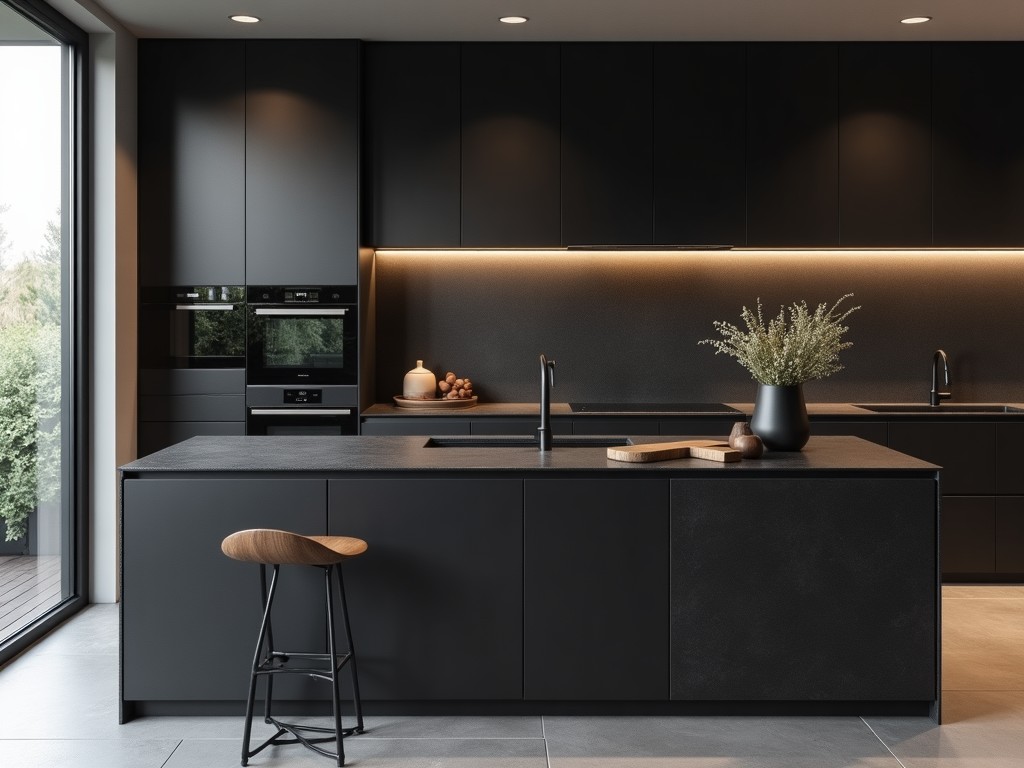
Matte black quartz countertops are engineered stone slabs composed of approximately 90% ground natural quartz aggregate and 10% polymer resin matrix, pigmented with inorganic black pigments to
Inquire NowMatte black quartz countertops are engineered stone slabs composed of approximately 90% ground natural quartz aggregate and 10% polymer resin matrix, pigmented with inorganic black pigments to achieve a uniform, low‑gloss finish.
The manufacturing process involves vacuum vibration compaction followed by curing at elevated temperatures, resulting in a non‑porous surface with consistent color depth.
Unlike polished variants, the matte finish is obtained by controlled abrasive polishing with diamond pads of graded grit, yielding a surface roughness (Ra) typically between 0.4 and 0.6 µm.
This texture reduces glare while maintaining the mechanical properties inherent to quartz composites.
Key performance indicators are measured according to ASTM and EN standards for engineered stone.
The following table lists typical values for a matte black quartz slab intended for commercial installations.
| Property | Typical Value | Test Method |
|---|---|---|
| Density | 2.32 g/cm³ | ASTM C97 |
| Flexural Strength | 55 MPa | ASTM C880 |
| Compressive Strength | 210 MPa | ASTM C170 |
| Water Absorption | 0.02 % | ASTM C97 |
| Coefficient of Thermal Expansion | 22 ×10⁻⁶ /°C | ASTM C531 |
| Mohs Hardness | 7 | ASTM C1353 |
| Stain Resistance (ASTM C1378) | No visible stain after 24 h exposure to coffee, oil, wine | ASTM C1378 |
The slab is produced in a continuous press line where quartz aggregate, resin, pigment, and additives are mixed under vacuum to eliminate entrapped air.
The mixture is then fed into a mold and subjected to vibration compaction at 1.5 g acceleration, achieving a green density >2.2 g/cm³.
Curing occurs in a heated chamber at 80–90 °C for 45 minutes, allowing the resin to cross‑link fully.
After curing, slabs undergo calibration to a nominal thickness of 20 mm (±0.5 mm) and are processed through a series of diamond abrasive belts.
The matte finish is achieved using 400‑grit to 800‑grit pads under controlled feed rate, producing the target surface roughness.
Final inspection includes spectrophotometric color measurement (ΔE < 1.5) and gloss meter reading (<10 GU at 60°).
Matte black quartz offers a low‑reflectance surface that reduces visual fatigue in high‑illumination settings such as laboratory benchtops, hospital nurse stations, and retail service counters.
Its non‑porous nature prevents bacterial ingress, meeting ISO 22196 for antimicrobial performance when supplemented with silver‑based additives.
In food‑processing facilities, the material resists penetration of acidic juices and oils, and its thermal shock tolerance (ΔT up to 110 °C) permits direct placement of hot pans without cracking.
The consistent color depth also simplifies replacement of damaged sections, as visual matching is reliable across production batches.
While the base product is a 20 mm thick matte black slab, dimensional adjustments are available to suit project requirements.
All custom dimensions are quoted based on slab utilization rates, with a typical material yield of 85 % for rectangular cuts.
Each production lot undergoes a systematic inspection protocol.
Dimensional accuracy is verified using laser scanners (±0.1 mm tolerance).
Color uniformity is assessed across five points per slab with a spectrophotometer; ΔE must remain below 1.5 relative to the master standard.
Mechanical properties are sampled per lot: three specimens for flexural strength, three for compressive strength, with acceptance limits set at 90 % of the typical values listed above.
Surface finish is measured with a profilometer; Ra must fall within 0.4–0.6 µm for matte classification.
Additionally, a chemical resistance test per ASTM C650 confirms no mass loss after 24 h immersion in 5 % acetic acid and 5 % sodium hydroxide solutions.
Documentation includes a material data sheet (MDS), test certificates, and a traceability label linking slab to batch number, production date, and machine ID.
Finished slabs are packed vertically on A‑frame pallets with corner protectors and edge foam.
Each pallet holds up to 10 slabs (depending on thickness) and is secured with PET straps.
The pallet base is heat‑treated lumber compliant with ISPM‑15 for international shipments.
For export, a moisture‑barrier wrap (PE film) is applied, and the pallet is placed inside a fumigated wooden crate when required by destination customs.
Typical lead time from order confirmation to shipment is 3–4 weeks, subject to slot availability in the press line.
Yes. Length, width, thickness, and edge profile can be tailored to project specifications. Custom cuts are priced based on slab utilization and require a shop drawing for approval.
Project layout (plan view), required thicknesses, edge details, quantity, delivery address, and any special certifications (e.g., NSF, ISO 9001).
Standard offering is 93 % quartz / 7 % resin with inorganic black pigment. Alternative formulations with higher resin content for increased flexibility or with recycled glass aggregates are available upon request.
Each lot undergoes dimensional, color, mechanical, and surface finish testing as described in the Quality Control section. Test certificates accompany each shipment.
Standard A‑frame pallets with corner protectors; optional wooden crates for high‑value or fragile shipments; custom packaging for OEM integration.
Please contact our engineering team for technical datasheets, sample requests, or project‑specific quotations.
Request Quote / SampleQueenswood delivers modern bathroom solutions through original design, advanced manufacturing, and reliable quality for customers worldwide.


Middle of Xingang East Road, Haizhu District, Guangzhou City, Guangdong Province

