
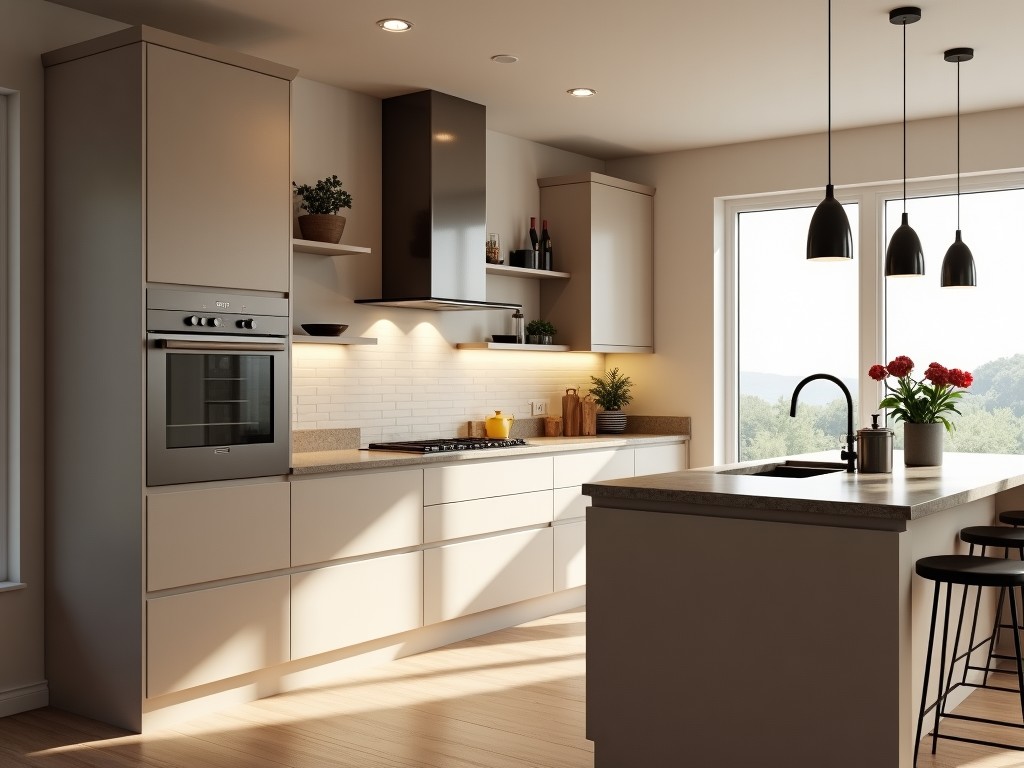
Diamond-patterned cabinetry combines a wear-resistant surface layer with a stable substrate to meet the demands of continuous-use commercial kitchens. The pattern is pressed into the face material,
Inquire NowDiamond-patterned cabinetry combines a wear-resistant surface layer with a stable substrate to meet the demands of continuous-use commercial kitchens. The pattern is pressed into the face material, creating micro‑texture that reduces visible scratches and simplifies cleaning routines.
Core panels are typically 18 mm thick, three‑layer particleboard or MDF with a balanced construction to minimize warp under humidity swings. A 0.6 mm diamond‑embossed melamine or thermofoil layer is vacuum‑pressed onto both faces, providing a uniform wear surface.
Edge sealing uses 2 mm PVC or ABS edgebanding, heat‑activated to achieve a seamless bond that resists delamination from steam exposure. Optional stainless‑steel edge profiles are available for high‑impact zones.
Cabinet boxes are fabricated to exact project dimensions using CNC routing, allowing for non‑standard heights, depths, and inset configurations required by equipment layouts.
The diamond pattern can be oriented vertically, horizontally, or diagonally, and the emboss depth can be adjusted between 0.2 mm and 0.5 mm to balance slip resistance with visual subtlety.
Panels are cut on 5‑axis CNC routers with ±0.1 mm positional accuracy, ensuring square joints and consistent reveal lines across multi‑unit runs.
After cutting, faces undergo a pre‑heat cycle (120 °C, 90 s) to activate the adhesive layer, followed by vacuum pressing at 0.8 bar for 45 seconds to achieve full bond without bubbles.
Edgebanding is applied via hot‑melt extrusion, then trimmed and buffed to a radius of 0.5 mm. Final inspection includes a 10× magnification check for emboss uniformity and edge adhesion.
| Property | Typical Value | Notes |
|---|---|---|
| Panel Thickness | 18 mm core + 0.6 mm face | Customizable to 22 mm for heavy‑load units |
| Density (core) | 650 kg/m³ (MR‑PB) | MDF core up to 750 kg/m³ |
| Surface Hardness (ISO 2813) | 2.5 H (pencil) | Resists scratching from utensils |
| Water Vapor Transmission Rate | ≤5 g/(m²·24 h) at 38 °C, 90 % RH | Meets EN 120‑2 for kitchen environments |
| Fire Classification (EN 13501‑1) | D‑s2, d0 (melamine face) | Optional fire‑retardant core upgrades to B‑s2, d0 |
| Load Capacity (shelf) | 150 kg uniformly distributed | Tested per ANSI/KCMA A161.1 |
In foodservice kitchens, the diamond texture reduces the visual impact of knife marks and provides a subtle grip that helps keep cutting boards from sliding during prep.
Hospitality outlets benefit from the surface’s resistance to staining from sauces, oils, and beverage spills, allowing cleaning with mild detergents without dulling the finish.
Laboratory and pharmaceutical settings require low‑outgassing surfaces; the sealed melamine face meets VOC limits (< 50 µg/m³) and supports routine disinfection with 70 % ethanol.
Retail bakery displays use the pattern to conceal minor abrasions from frequent product rotation while maintaining a bright, uniform appearance under display lighting.
Each batch undergoes dimensional verification: length, width, and diagonal tolerance ±0.5 mm; thickness variation across a sheet ≤0.2 mm.
Surface inspection uses a standardized lighting booth (45°/0° geometry) to detect emboss defects, with acceptance criteria of no more than two visible blemishes per square meter.
Adhesion strength of the face layer is measured by a peel test (ASTM D903); minimum acceptable value is 1.8 N/mm.
1. Technical consultation – client supplies layout sketches, equipment clearances, and desired finish samples.
2. CAD modeling – detailed 3‑D files generated, including panel cut lists, hardware placements, and diamond‑orientation maps.
3. Approval loop – PDF renderings and material swatches returned for sign‑off; revisions tracked via version control.
4. Production release – CNC programs loaded, material sourced, and press schedules locked.
5. Final inspection & packaging – each unit receives a QR‑coded label linking to its inspection record.
6. Delivery – pallets stacked according to unload sequence, with shock‑watch indicators for transit monitoring.
Yes. All cabinets are produced to project‑specific width, height, and depth tolerances, with filler strips available for on‑site adjustments.
A basic layout (plan view), desired material substrate, face finish code, hardware preferences, and any regulatory constraints (e.g., fire rating).
Standard options include melamine‑impregnated paper, PET‑based thermofoil, and low‑VOC acrylic foil. Custom foil developments can be quoted upon request.
Each unit undergoes dimensional checks, surface appearance review under controlled lighting, and adhesive peel testing. Records are stored digitally and accessible via the QR label.
Panels are wrapped in polyethylene sheeting, corner‑protected with recycled cardboard, and strapped to heat‑treated pallets. A desiccant packet controls humidity inside the wrap.
Lead time ranges from 3‑4 weeks for standard configurations to 6‑8 weeks for custom foil or fire‑retardant core options, subject to material availability.
To begin a consultation, share your project specifications, and our engineering team will return a detailed quote with lead times, material data sheets, and CAD drawings.
Request QuoteQueenswood delivers modern bathroom solutions through original design, advanced manufacturing, and reliable quality for customers worldwide.


Middle of Xingang East Road, Haizhu District, Guangzhou City, Guangdong Province

