
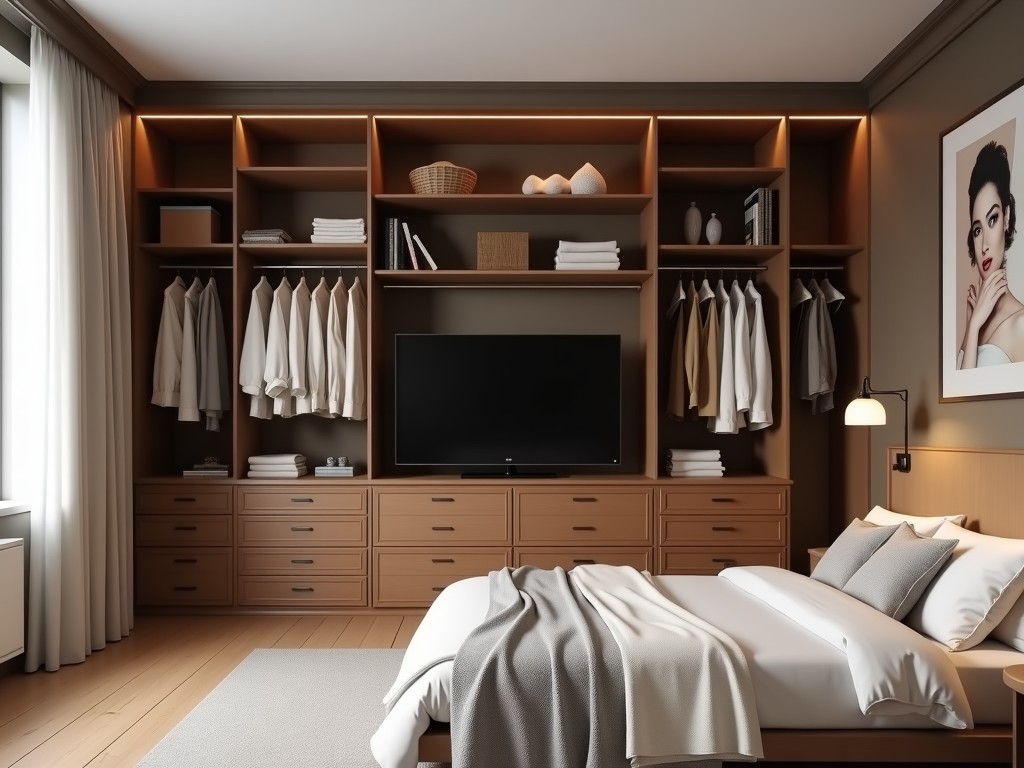
Reach‑in closet systems are engineered for installations where access is limited to a single opening, common in retail back‑rooms, hotel housekeeping closets, and medical supply rooms. The design
Inquire NowReach‑in closet systems are engineered for installations where access is limited to a single opening, common in retail back‑rooms, hotel housekeeping closets, and medical supply rooms. The design focuses on maximizing usable depth while maintaining structural integrity under repeated loading cycles.
Each unit begins with a structural frame calculated to support a uniform distributed load of up to 150 kg per shelf without exceeding a deflection limit of L/200, where L is the clear span between vertical supports. This criterion ensures that stored items remain level and that hardware does not experience premature fatigue.
Frames are fabricated from cold‑rolled steel profiles with a minimum yield strength of 250 MPa. The typical material thickness is 1.5 mm for upright posts and 1.2 mm for horizontal rails, providing a high strength‑to‑weight ratio suitable for frequent reconfiguration.
Material options are selected based on environmental exposure and aesthetic requirements. The following table outlines typical characteristics; exact values can be adjusted per project specifications.
| Material | Typical Thickness | Yield Strength | Corrosion Resistance | Finish Options |
|---|---|---|---|---|
| Cold‑rolled steel | 1.2 mm – 2.0 mm | ≥250 MPa | Standard (requires coating) | Powder coat, galvanized, epoxy |
| Aluminum alloy 6063‑T5 | 1.5 mm – 2.5 mm | ≥150 MPa | Natural oxide layer | Anodized, powder coat, PVDF |
| High‑pressure laminate (HPL) over particle board | 18 mm board + 0.7 mm laminate | N/A (non‑structural) | Moisture resistant (MR grade) | Various colors, wood grain, solid |
Customization follows a parametric workflow. Customers provide opening height, width, and desired interior clearance; the system generates a bill of materials with exact cut lengths, hole patterns, and accessory placements. Adjustable shelf pins accommodate vertical increments of 25 mm, allowing re‑spacing without tools.
Accessories include soft‑close drawer glides rated for 30 kg dynamic load, ventilated shoe racks with perforated steel sides (open area 45 %), and LED light strips with IP44 rating for humid environments. Each accessory is designed to attach to the frame via M5 threaded inserts, ensuring repeatable torque of 4 Nm.
Applications benefit from the system’s ability to fit within narrow recesses while delivering high storage density. In hotel housekeeping, a reach‑in unit measuring 600 mm deep can house linens, cleaning carts, and guest amenities within a 1.2 m wide alcove, reducing corridor congestion. In medical settings, antimicrobial powder‑coat finishes meet ISO 22196 standards, supporting infection control protocols.
Quality control is integrated at each fabrication stage. Laser‑cut tolerances are held to ±0.2 mm, and all welded seams undergo visual inspection followed by ultrasonic testing for penetration depth ≥80 % of material thickness. Finished units receive a 24‑hour salt‑spray test (ASTM B117) to verify coating adhesion, with acceptance criteria of less than 5 % rust formation after 500 hours.
Typical lead time for a custom reach‑in closet system ranges from 4 to 6 weeks after approval of final drawings, depending on material selection and order volume. Packaging uses corner protectors, stretch film, and palletized crates rated for ISTA‑3A transit safety, minimizing risk of damage during long‑haul shipment.
Can dimensions be customized to fit non‑standard openings?
Yes. The parametric design engine accepts any height, width, and depth within structural limits (maximum clear span 1200 mm for upright posts). Provide the rough opening measurements and any obstructions; the system will generate a fitting solution.
What information is required before a quotation can be issued?
A preliminary sketch or CAD file showing the opening, intended load per shelf, preferred material finish, and any accessory needs (e.g., lighting, locks). Environmental conditions (humidity, temperature) help determine corrosion‑protection specifications.
How is quality inspected for bulk orders?
Each production lot undergoes sampling inspection per AQL 1.0 for critical dimensions and finish quality. Functional tests include load‑deflection verification on three random units per lot and cycle testing of moving parts (5000 operations) to ensure durability.
What packaging methods protect finishes during export?
Units are wrapped in anti‑static polyethylene film, placed in corrugated board sleeves with edge guards, and secured to heat‑treated pallets. For overseas shipments, desiccant packets and humidity indicators are included to monitor interior moisture levels.
Queenswood delivers modern bathroom solutions through original design, advanced manufacturing, and reliable quality for customers worldwide.


Middle of Xingang East Road, Haizhu District, Guangzhou City, Guangdong Province

