
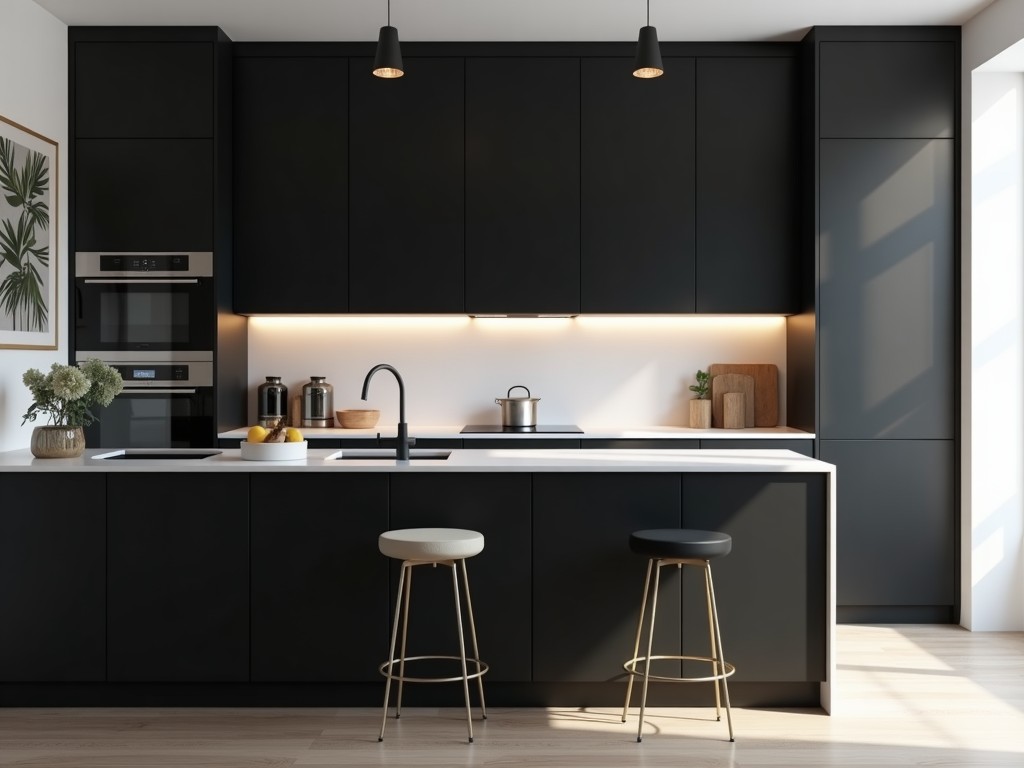
Black finishes on kitchen cabinets are typically achieved through catalyzed lacquer or thermofoil processes that provide a uniform, low‑gloss surface resistant to staining and fading. The coating
Inquire NowBlack finishes on kitchen cabinets are typically achieved through catalyzed lacquer or thermofoil processes that provide a uniform, low‑gloss surface resistant to staining and fading. The coating thickness usually ranges from 30 to 50 µm, offering measurable abrasion resistance suitable for high‑traffic commercial kitchens. This base layer also acts as a barrier against moisture ingress, protecting the substrate core.
Substrate options include particleboard with melamine overlay, medium‑density fiberboard (MDF), or plywood cores, each selected based on load‑bearing requirements and environmental conditions. Particleboard cores typically achieve a modulus of rupture around 18 MPa, while MDF offers higher internal bond strength exceeding 0.8 MPa. Plywood provides cross‑grain stability, reducing warping in humid environments.
Custom dimensions are specified in 1 mm increments, allowing precise alignment with appliance envelopes and wall studs. Standard cabinet depths range from 560 mm to 610 mm, while heights can be adjusted from 720 mm to 960 mm to accommodate soffits or ceiling clearances. Width modules typically start at 150 mm and increase in 50 mm steps, enabling tight filler strips or oversized pantry units.
Hardware mounting points are pre‑drilled to ISO 9001‑specified hole patterns, ensuring compatibility with concealed hinges, soft‑close runners, and pull‑out shelving systems. Hole diameters are typically 5 mm for cam bolts and 8 mm for shelf pins, with positional tolerance ±0.2 mm. Reinforcing brackets can be added at corners to increase shear capacity by up to 25 %.
Edge banding is applied using PVC or ABS strips, thermally bonded to achieve a seamless finish that matches the cabinet face color. Band thickness is usually 0.8 mm, providing impact resistance and preventing delamination under repeated cleaning cycles. Edge band adhesion strength exceeds 1.5 MPa in peel tests, meeting typical commercial kitchen standards.
In commercial kitchens, cabinets must endure frequent cleaning with alkaline detergents and temperature fluctuations from cooking equipment. The black finish’s low‑gloss surface reduces glare under bright lighting, improving visual comfort for staff during long shifts. Additionally, the uniform color conceals minor scratches, maintaining a professional appearance over extended service life.
Installation relies on a levelled sub‑wall and adjustable hanging rails that accommodate wall irregularities up to 5 mm deviation. Load calculations typically assume a uniformly distributed load of 150 N per shelf, with safety factors applied per local building codes. Concealed fastening systems transfer load directly to the wall studs, minimizing reliance on adhesive bonds.
| Specification | Value / Options |
|---|---|
| Cabinet Depth | 560 mm – 610 mm (customizable) |
| Cabinet Height | 720 mm – 960 mm (customizable) |
| Width Module | 150 mm increments (starting at 150 mm) |
| Substrate | Particleboard, MDF, Plywood (custom) |
| Finish | Catalyzed lacquer, Thermofoil, UV‑cured acrylic (black) |
| Edge Band | PVC/ABS, 0.8 mm thickness |
| Hinge Hole Pattern | ISO 9001, 5 mm cam, 8 mm shelf pin |
| Shelf Load Capacity | 150 N uniformly distributed (per shelf) |
| Moisture Resistance | ≤0.2 % weight gain after 24 h immersion (typical) |
Contact our engineering team to discuss your project requirements and receive a detailed quotation.
Queenswood delivers modern bathroom solutions through original design, advanced manufacturing, and reliable quality for customers worldwide.


Middle of Xingang East Road, Haizhu District, Guangzhou City, Guangdong Province

