
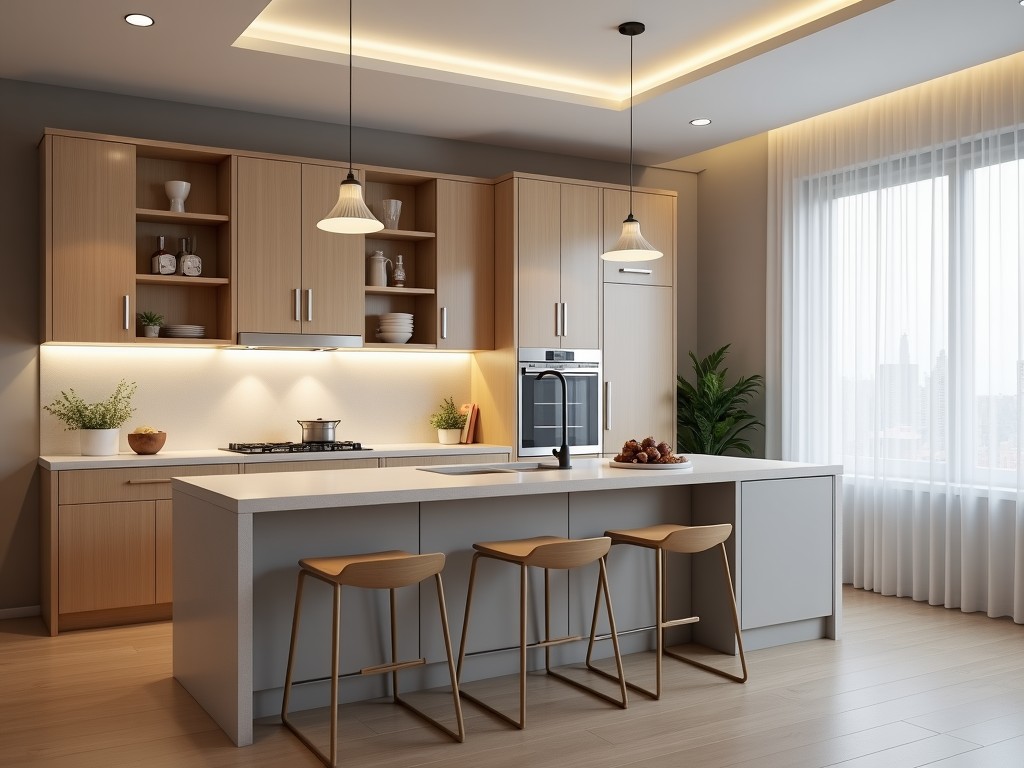
Custom kitchen cabinets are built to specific dimensions, finishes, and hardware requirements defined by the project design. The price reflects labor, material selection, hardware, and any additional
Inquire NowCustom kitchen cabinets are built to specific dimensions, finishes, and hardware requirements defined by the project design. The price reflects labor, material selection, hardware, and any additional features such as soft‑close mechanisms or integrated lighting.
Understanding the cost drivers helps procurement teams compare quotes accurately and avoid unexpected expenses during installation.
| Material | Typical Cost Range (USD per linear foot) | Key Characteristics |
|---|---|---|
| Solid Hardwood (Maple, Oak, Cherry) | 120‑180 | High durability, natural grain, can be refinished. |
| Veneer‑over‑Plywood | 80‑130 | Stable core, consistent appearance, lower movement. |
| MDF with Paint Grade Finish | 60‑100 | Smooth surface for uniform paint, stable in humidity. |
| Particleboard with Laminate | 45‑75 | Economical, resistant to staining, limited load capacity. |
| Cabinet Type | Price Range (USD per linear foot) | Common Use |
|---|---|---|
| Base Cabinets | 70‑150 | Floor‑mounted, hold countertop and appliances. |
| Wall Cabinets | 60‑130 | Mounted at eye level, store dishes and pantry items. |
| Tall/Pantry Cabinets | 80‑180 | Floor‑to‑ceiling storage for bulk items or appliances. |
The process begins with detailed shop drawings that specify cabinet box dimensions, door overlay, and hardware locations.
Material sheets are cut to size using CNC routers, ensuring tight tolerances (±0.5 mm) for repeatable fit.
Edges are banded or profiled according to the selected finish, and doors are machined for hinges or concealed hardware.
After assembly, surfaces undergo sanding, priming, and coating steps that match the specified gloss level and color.
Final hardware installation and functional testing confirm alignment and operation before packaging.
Production capacity is influenced by the complexity of door profiles; intricate raised‑panel designs increase cycle time per unit.
Finish curing times vary: water‑based paints may require 24 hours between coats, while UV‑cured laminates can be handled immediately after exposure.
Material movement must be accounted for in wide panels; engineered cores reduce seasonal expansion compared to solid wood.
Dimensional checks are performed at each station using calibrated gauges to verify width, height, and depth within tolerance.
Surface inspection includes gloss meter readings and adhesion tests (cross‑hatch) to ensure coating durability.
Hardware torque is validated with calibrated drivers to prevent over‑tightening that could strip screw holes.
Finished units undergo a 48‑hour climate conditioning cycle to assess any warping or finish cracking before shipment.
Custom cabinets are specified when the kitchen layout demands non‑standard widths, such as irregular wall angles or appliance garages.
They enable integration of specialized storage solutions like vertical pull‑out trays for baking sheets or hidden waste compartments.
In commercial settings, custom cabinetry supports branding through unique finishes and logo‑embossed panels while meeting heavy‑duty usage requirements.
Can dimensions be customized to millimeter precision?
Yes, CNC cutting allows tolerances of ±0.5 mm for width, height, and depth.
What information is required before quotation?
Detailed layout drawings, material preferences, finish specifications, hardware list, and any accessory requirements.
What materials are available?
Solid hardwoods, veneer‑over‑plywood, MDF, and particleboard with various laminate or paint finishes.
How is quality inspected?
Dimensional gauges, gloss meters, adhesion tests, hardware torque verification, and climate conditioning checks.
What packaging methods are available?
Flat‑pack in corrugated cartons with corner protectors, or fully assembled crates with foam cushioning for high‑gloss units.
How are export shipments protected?
Palletized, shrink‑wrapped, and sealed with moisture‑barrier film; additional corner bracing for long‑haul transit.
What is the typical production lead time?
4‑6 weeks after drawing approval, depending on material availability and finish complexity.
How are samples arranged?
Sample doors or full‑size cabinet sections can be shipped upon request, with freight charges applicable.
Provide your layout drawings, material preferences, and required accessories to receive a detailed, itemized quotation.
Queenswood delivers modern bathroom solutions through original design, advanced manufacturing, and reliable quality for customers worldwide.


Middle of Xingang East Road, Haizhu District, Guangzhou City, Guangdong Province

